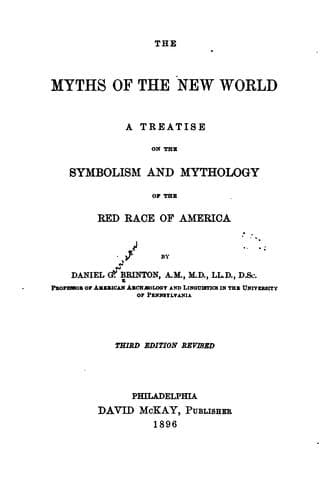
The Myths of the New World: A Treatise on the Symbolism and Mythology of the Red Race of AmericaBrinton, Daniel G. (Daniel Garrison)
Religion
The Myths of the New World: A Treatise on the Symbolism and Mythology of the Red Race of America
Brinton, Daniel G. (Daniel Garrison)
Indian mythology; Indians -- Folklore
None of these is more common or more natural than that which attributes
to the emancipated spirit the same wants that it felt while on earth,
and with loving foresight provides for their satisfaction. Clothing and
utensils of war and the chase were, in ancient times, uniformly placed
by the body, under the impression that they would be of service to the
departed in his new home. Some few tribes in the far west still retain
the custom, but most were soon ridiculed into its neglect, or were
forced to omit it by the violation of tombs practised by depraved whites
in hope of gain. To these harmless offerings the northern tribes often
added a dog slain on the grave; and doubtless the skeletons of these
animals in so many tombs in Mexico and Peru point to similar customs
there. It had no deeper meaning than to give a companion to the spirit
in its long and lonesome journey to the far off land of shades. The
peculiar appropriateness of the dog arose not only from the guardianship
it exerts during life, but further from the symbolic signification it so
often had as representative of the goddess of night and the grave.
Where a despotic form of government reduced the subject almost to the
level of a slave and elevated the ruler almost to that of a superior
being, not animals only, but men, women, and children were frequently
immolated at the tomb of the cacique. The territory embraced in our own
country was not without examples of this horrid custom. On the lower
Mississippi, the Natchez Indians brought it with them from Central
America in all its ghastliness. When a sun or chief died, one or several
of his wives and his highest officers were knocked on the head and
buried with him, and at such times the barbarous privilege was allowed
to any of the lowest caste to at once gain admittance to the highest by
the deliberate murder of their own children on the funeral pyre--a
privilege which respectable writers tell us human beings were found base
enough to take advantage of.[239-1]
Oviedo relates that in the province of Guataro, in Guatemala, an actual
rivalry prevailed among the people to be slain at the death of their
cacique, for they had been taught that only such as went with him would
ever find their way to the paradise of the departed.[240-1] Theirs was
therefore somewhat of a selfish motive, and only in certain parts of
Peru, where polygamy prevailed, and the rule was that only one wife was
to be sacrificed, does the deportment of husbands seem to have been so
creditable that their widows actually disputed one with another for the
pleasure of being buried alive with the dead body, and bearing their
spouse company to the other world.[240-2] Wives who have found few
parallels since the famous matron of Ephesus!
Public-domain text, read in full here on John Shaqi.
Reviews
Reviews
No reviews yet
Be the first to share your thoughts on this work.
Elsewhere in the archive
Join the Discussion
Join the discussion
Sign in to leave a comment or review.
Sign InorCreate an account