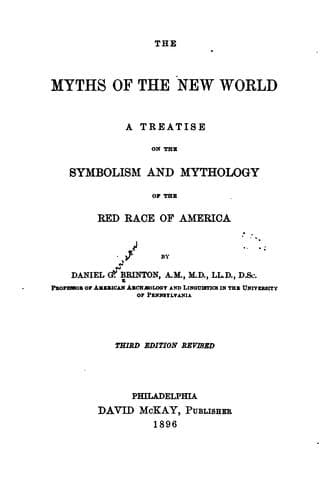
The Myths of the New World: A Treatise on the Symbolism and Mythology of the Red Race of AmericaBrinton, Daniel G. (Daniel Garrison)
Religion
The Myths of the New World: A Treatise on the Symbolism and Mythology of the Red Race of America
Brinton, Daniel G. (Daniel Garrison)
Indian mythology; Indians -- Folklore
The fire built nightly on the grave was to light the spirit on his
journey. By a coincidence to be explained by the universal sacredness of
the number, both Algonkins and Mexicans maintained it for _four_ nights
consecutively. The former related the tradition that one of their
ancestors returned from the spirit land and informed their nation that
the journey thither consumed just _four_ days, and that collecting fuel
every night added much to the toil and fatigue the soul encountered, all
of which could be spared it by the relatives kindling nightly a fire on
the grave. Or as Longfellow has told it:--
"Four days is the spirit's journey
To the land of ghosts and shadows,
Four its lonely night encampments.
Therefore when the dead are buried,
Let a fire as night approaches
Four times on the grave be kindled,
That the soul upon its journey
May not grope about in darkness."
The same length of time, say the Navajos, does the departed soul wander
over a gloomy marsh ere it can discover the ladder leading to the world
below, where are the homes of the setting and the rising sun, a land of
luxuriant plenty, stocked with game and covered with corn. To that land,
say they, sink all lost seeds and germs which fall on the earth and do
not sprout. There below they take root, bud, and ripen their
fruit.[241-1]
After four days, once more, in the superstitions of the Greenland
Eskimos, does the soul, for that term after death confined in the body,
at last break from its prison-house and either rise in the sky to dance
in the aurora borealis or descend into the pleasant land beneath the
earth, according to the manner of death.[241-2]
That there are logical contradictions in this belief and these
ceremonies, that the fire is always in the same spot, that the weapons
and utensils are not carried away by the departed, and that the food
placed for his sustenance remains untouched, is very true. But those who
would therefore argue that they were not intended for the benefit of the
soul, and seek some more recondite meaning in them as "unconscious
emblems of struggling faith or expressions of inward emotions,"[242-1]
are led astray by the very simplicity of their real intention. Where is
the faith, where the science, that does not involve logical
contradictions just as gross as these? They are tolerable to us merely
because we are used to them. What value has the evidence of the senses
anywhere against a religious faith? None whatever. A stumbling block
though this be to the materialist, it is the universal truth, and as
such it is well to accept it as an experimental fact.
Public-domain text, read in full here on John Shaqi.
Reviews
Reviews
No reviews yet
Be the first to share your thoughts on this work.
Elsewhere in the archive
Join the Discussion
Join the discussion
Sign in to leave a comment or review.
Sign InorCreate an account