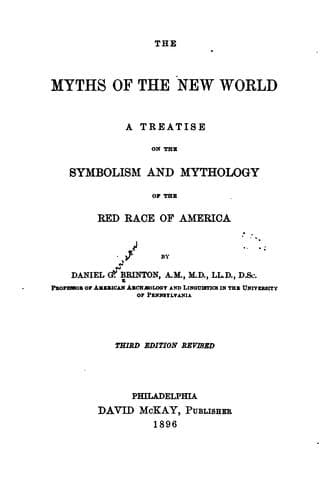
The Myths of the New World: A Treatise on the Symbolism and Mythology of the Red Race of AmericaBrinton, Daniel G. (Daniel Garrison)
Religion
The Myths of the New World: A Treatise on the Symbolism and Mythology of the Red Race of America
Brinton, Daniel G. (Daniel Garrison)
Indian mythology; Indians -- Folklore
Those who have complained of the hopeless confusion of American
religions have but proven the insufficiency of their own means of
analyzing them. The uniformity which they display in so many points is
nowhere more fully illustrated than in the unanimity with which they all
point to the _sun_ as the land of the happy souls, the realm of the
blessed, the scene of the joyous hunting-grounds of the hereafter. Its
perennial glory, its comfortable warmth, its daily analogy to the life
of man, marked its abode as the pleasantest spot in the universe. It
matters not whether the eastern Algonkins pointed to the south, others
of their nation, with the Iroquois and Creeks, to the west, or many
tribes to the east, as the direction taken by the spirit; all these
myths but mean that its bourn is the home of the sun, which is perhaps
in the Orient whence he comes forth, in the Occident where he makes his
bed, or in the South whither he retires in the chilling winter. Where
the sun lives, they informed the earliest foreign visitors, were the
villages of the deceased, and the milky way which nightly spans the arch
of heaven, was, in their opinion, the road that led thither, and was
called the path of the souls (_le chemin des ames_).[244-1] To _hueyu
ku_, the mansion of the sun, said the Caribs, the soul passes when death
overtakes the body.[244-2] Our knowledge is scanty of the doctrines
taught by the Incas concerning the soul, but this much we do know, that
they looked to the sun, their recognized lord and protector, as he who
would care for them at death, and admit them to his palaces. There--not,
indeed, exquisite joys--but a life of unruffled placidity, void of
labor, vacant of strong emotions, a sort of material Nirvana, awaited
them.[244-3] For these reasons, they, with most other American nations,
interred the corpse lying east and west, and not as the traveller Meyen
has suggested,[244-4] from the reminiscences of some ancient migration.
Beyond the Cordilleras, quite to the coast of Brazil, the innumerable
hordes who wandered through the sombre tropical forests of that immense
territory, also pointed to the west, to the region beyond the mountains,
as the land where the souls of their ancestors lived in undisturbed
serenity; or, in the more brilliant imaginations of the later
generations, in a state of perennial inebriety, surrounded by infinite
casks of rum, and with no white man to dole it out to them.[245-1] The
natives of the extreme south, of the Pampas and Patagonia, suppose the
stars are the souls of the departed. At night they wander about the sky,
but the moment the sun rises they hasten to the cheerful light, and are
seen no more until it disappears in the west. So the Eskimo of the
distant north, in the long winter nights when the aurora bridges the sky
with its changing hues and arrowy shafts of light, believes he sees the
spirits of his ancestors clothed in celestial raiment, disporting
Public-domain text, read in full here on John Shaqi.
Reviews
Reviews
No reviews yet
Be the first to share your thoughts on this work.
Elsewhere in the archive
Join the Discussion
Join the discussion
Sign in to leave a comment or review.
Sign InorCreate an account