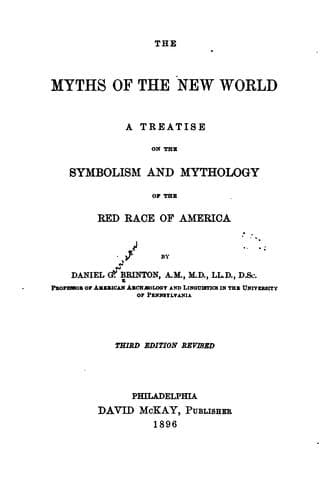
The Myths of the New World: A Treatise on the Symbolism and Mythology of the Red Race of AmericaBrinton, Daniel G. (Daniel Garrison)
Religion
The Myths of the New World: A Treatise on the Symbolism and Mythology of the Red Race of America
Brinton, Daniel G. (Daniel Garrison)
Indian mythology; Indians -- Folklore
themselves in the absence of the sun, and calls the phenomenon _the
dance of the dead_.
The home of the sun was the heaven of the red man; but to this joyous
abode not every one without distinction, no miscellaneous crowd, could
gain admittance. The conditions were as various as the national
temperaments. As the fierce gods of the Northmen would admit no soul to
the banquets of Walhalla but such as had met the "spear-death" in the
bloody play of war, and shut out pitilessly all those who feebly
breathed their last in the "straw death" on the couch of sickness, so
the warlike Aztec race in Nicaragua held that the shades of those who
died in their beds went downward and to naught; but of those who fell
in battle for their country to the east, "to the place whence comes the
sun."[246-1] In ancient Mexico not only the warriors who were thus
sacrificed on the altar of their country, but with a delicate and
poetical sense of justice that speaks well for the refinement of the
race, also those women who perished in child-birth, were admitted to the
home of the sun. For are not they also heroines in the battle of life?
Are they not also its victims? And do they not lay down their lives for
country and kindred? Every morning, it was imagined, the heroes came
forth in battle array, and with shout and song and the ring of weapons,
accompanied the sun to the zenith, where at every noon the souls of the
mothers, the Cihuapipilti, received him with dances, music, and flowers,
and bore him company to his western couch.[246-2] Except these,
none--without, it may be, the victims sacrificed to the gods, and this
is doubtful--were deemed worthy of the highest heaven.
A mild and unwarlike tribe of Guatemala, on the other hand, were
persuaded that to die by any other than a natural death was to forfeit
all hope of life hereafter, and therefore left the bodies of the slain
to the beasts and vultures.
The Mexicans had another place of happiness for departed souls, not
promising perpetual life as the home of the sun, but unalloyed pleasure
for a certain term of years. This was Tlalocan, the realm of the god of
rains and waters, the terrestrial paradise, whence flowed all the
rivers of the earth, and all the nourishment of the race. The diseases
of which persons died marked this destination. Such as were drowned, or
struck by lightning, or succumbed to humoral complaints, as dropsies and
leprosy, were by these tokens known to be chosen as the subjects of
Tlaloc. To such, said the natives, "death is the commencement of another
life, it is as waking from a dream, and the soul is no more human but
divine (_teot_)." Therefore they addressed their dying in terms like
these: "Sir, or lady, awake, awake; already does the dawn appear; even
now is the light approaching; already do the birds of yellow plumage
begin their songs to greet thee; already are the gayly-tinted
butterflies flitting around thee."[247-1]
Public-domain text, read in full here on John Shaqi.
Reviews
Reviews
No reviews yet
Be the first to share your thoughts on this work.
Elsewhere in the archive
Join the Discussion
Join the discussion
Sign in to leave a comment or review.
Sign InorCreate an account