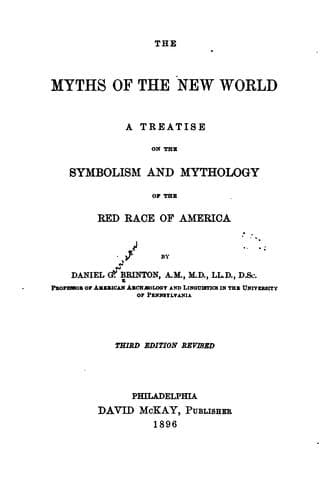
The Myths of the New World: A Treatise on the Symbolism and Mythology of the Red Race of AmericaBrinton, Daniel G. (Daniel Garrison)
Religion
The Myths of the New World: A Treatise on the Symbolism and Mythology of the Red Race of America
Brinton, Daniel G. (Daniel Garrison)
Indian mythology; Indians -- Folklore
Before proceeding to the more gloomy portion of the subject, to the
destiny of those souls who were not chosen for the better part, I must
advert to a curious coincidence in the religious reveries of many
nations which finds its explanation in the belief that the house of the
sun is the home of the blessed, and proves that this was the first
conception of most natural religions. It is seen in the events and
obstacles of the journey to the happy land. We everywhere hear of a
water which the soul must cross, and an opponent, either a dog or an
evil spirit, which it has to contend with. We are all familiar with the
dog Cerberus (called by Homer simply "the dog"), which disputed the
passage of the river Styx over which the souls must cross; and with the
custom of the vikings, to be buried in a boat so that they might cross
the waters of Ginunga-gap to the inviting strands of Godheim. Relics of
this belief are found in the Koran which describes the bridge _el
Sirat_, thin as a hair and sharp as a scimetar,[TN-13] stretched in a
single span from heaven to earth; in the Persian legend, where the
rainbow arch Chinevad is flung across the gloomy depths between this
world and the home of the happy; and even in the current Christian
allegory which represents the waters of the mythical Jordan rolling
between us and the Celestial City.
How strange at first sight does it seem that the Hurons and Iroquois
should have told the earliest missionaries that after death the soul
must cross a deep and swift river on a bridge formed by a single slender
tree most lightly supported, where it had to defend itself against the
attacks of a dog?[248-1] If only they had expressed this belief, it
might have passed for a coincidence merely. But the Athapascas
(Chepewyans) also told of a great water, which the soul must cross in a
stone canoe; the Algonkins and Dakotas, of a stream bridged by an
enormous snake, or a narrow and precipitous rock, and the Araucanians of
Chili of a sea in the west, in crossing which the soul was required to
pay toll to a malicious old woman. Were it unluckily impecunious, she
deprived it of an eye.[248-2] With the Aztecs this water was called
Chicunoapa, the Nine Rivers. It was guarded by a dog and a green dragon,
to conciliate which the dead were furnished with slips of paper by way
of toll. The Greenland Eskimos thought that the waters roared through
an unfathomable abyss over which there was no other bridge than a wheel
slippery with ice, forever revolving with fearful rapidity, or a path
narrow as a cord with nothing to hold on by. On the other side sits a
horrid old woman gnashing her teeth and tearing her hair with rage. As
each soul approaches she burns a feather under its nose; if it faints
she seizes it for her prisoner, but if the soul's guardian spirit can
overcome her, it passes through in safety.[249-1]
Public-domain text, read in full here on John Shaqi.
Reviews
Reviews
No reviews yet
Be the first to share your thoughts on this work.
Elsewhere in the archive
Join the Discussion
Join the discussion
Sign in to leave a comment or review.
Sign InorCreate an account