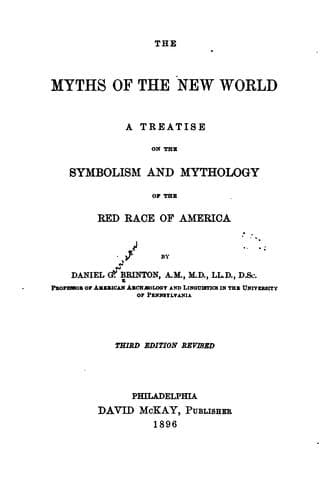
The Myths of the New World: A Treatise on the Symbolism and Mythology of the Red Race of AmericaBrinton, Daniel G. (Daniel Garrison)
Religion
The Myths of the New World: A Treatise on the Symbolism and Mythology of the Red Race of America
Brinton, Daniel G. (Daniel Garrison)
Indian mythology; Indians -- Folklore
Çupay or Supay, the Shadow, in Peru was supposed to rule the land of
shades in the centre of the earth. To him went all souls not destined to
be the companions of the Sun. This is all we know of his attributes; and
the assertion of Garcilasso de la Vega, that he was the analogue of the
Christian Devil, and that his name was never pronounced without spitting
and muttering a curse on his head, may be invalidated by the testimony
of an earlier and better authority on the religion of Peru, who calls
him the god of rains, and adds that the famous Inca, Huayna Capac, was
his high priest.[251-1]
"The devil," says Cogolludo of the Mayas, "is called by them
Xibilha,[TN-14] which means he who disappears or vanishes."[251-2] In the
legends of the Quichés, the name Xibalba is given as that of the
under-world ruled by the grim lords One Death and Seven Deaths. The
derivation of the name is from a root meaning to fear, from which comes
the term in Maya dialects for a ghost or phantom.[251-3] Under the
influence of a century of Christian catechizing, the Quiché legends
portray this really as a place of torment, and its rulers as malignant
and powerful; but as I have before pointed out, they do so, protesting
that such was not the ancient belief, and they let fall no word that
shows that it was regarded as the destination of the morally bad. The
original meaning of the name given by Cogolludo points unmistakably to
the simple fact of disappearance from among men, and corresponds in
harmlessness to the true sense of those words of fear, Scheol, Hades,
Hell, all signifying hidden from sight, and only endowed with more grim
associations by the imaginations of later generations.[252-1]
Mictlanteuctli, Lord of Mictlan, from a word meaning to die, was the
Mexican Pluto. Like Çupay, he dwelt in the subterranean regions, and his
palace was named Tlalxicco, the navel of the earth. Yet he was also
located in the far north, and that point of the compass and the north
wind were named after him. Those who descended to him were oppressed by
the darkness of his abode, but were subjected to no other trials; nor
were they sent thither as a punishment, but merely from having died of
diseases unfitting them for Tlalocan. Mictlanteuctli was said to be the
most powerful of the gods. For who is stronger than Death? And who dare
defy the Grave? As the skald lets Odin say to Bragi: "Our lot is
uncertain; even on the hosts of the gods gazes the gray Fenris
wolf."[252-2]
Public-domain text, read in full here on John Shaqi.
Reviews
Reviews
No reviews yet
Be the first to share your thoughts on this work.
Elsewhere in the archive
Join the Discussion
Join the discussion
Sign in to leave a comment or review.
Sign InorCreate an account