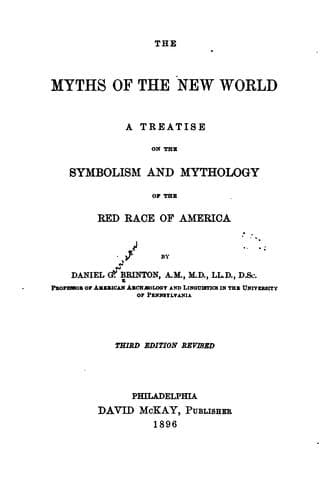
The Myths of the New World: A Treatise on the Symbolism and Mythology of the Red Race of AmericaBrinton, Daniel G. (Daniel Garrison)
Religion
The Myths of the New World: A Treatise on the Symbolism and Mythology of the Red Race of America
Brinton, Daniel G. (Daniel Garrison)
Indian mythology; Indians -- Folklore
These various abodes to which the incorporeal man took flight were not
always his everlasting home. It will be remembered that where a
plurality of souls was believed, one of these, soon after death,
entered another body to recommence life on earth. Acting under this
persuasion, the Algonkin women who desired to become mothers, flocked to
the couch of those about to die, in hope that the vital principle, as it
passed from the body, would enter theirs, and fertilize their sterile
wombs; and when, among the Seminoles of Florida, a mother died in
childbirth, the infant was held over her face to receive her parting
spirit, and thus acquire strength and knowledge for its future
use.[253-1] So among the Tahkalis, the priest is accustomed to lay his
hand on the head of the nearest relative of the deceased, and to blow
into him the soul of the departed, which is supposed to come to life in
his next child.[253-2] Probably, with a reference to the current
tradition that ascribes the origin of man to the earth, and likens his
life to that of the plant, the Mexicans were accustomed to say that at
one time all men have been stones, and that at last they would all
return to stones;[253-3] and, acting literally on this conviction, they
interred with the bones of the dead a small green stone, which was
called the principle of life.
Whether any nations accepted the doctrine of metempsychosis, and thought
that "the souls of their grandams might haply inhabit a partridge," we
are without the means of knowing. La Hontan denies it positively of the
Algonkins; but the natives of Popoyan refused to kill doves, says
Coreal,[254-1] because they believe them inspired by the souls of the
departed. And Father Ignatius Chomé relates that he heard a woman of the
Chiriquanes in Buenos Ayres say of a fox: "May that not be the spirit of
my dead daughter?"[254-2] But before accepting such testimony as
decisive, we must first inquire whether these tribes believed in a
multiplicity of souls, whether these animals had a symbolical value, and
if not, whether the soul was not simply presumed to put on this shape in
its journey to the land of the hereafter: inquiries which are
unanswered. Leaving, therefore, the question open, whether the sage of
Samos had any disciples in the new world, another and more fruitful
topic is presented by their well-ascertained notions of the resurrection
of the dead.
Public-domain text, read in full here on John Shaqi.
Reviews
Reviews
No reviews yet
Be the first to share your thoughts on this work.
Elsewhere in the archive
Join the Discussion
Join the discussion
Sign in to leave a comment or review.
Sign InorCreate an account