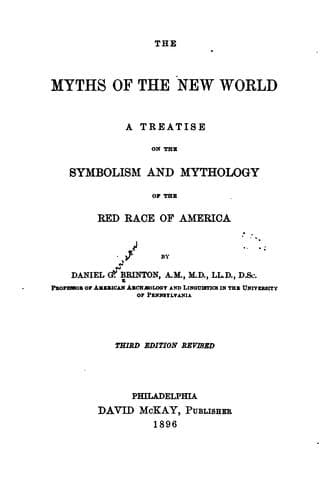
The Myths of the New World: A Treatise on the Symbolism and Mythology of the Red Race of AmericaBrinton, Daniel G. (Daniel Garrison)
Religion
The Myths of the New World: A Treatise on the Symbolism and Mythology of the Red Race of America
Brinton, Daniel G. (Daniel Garrison)
Indian mythology; Indians -- Folklore
But mythology and supersitions[TN-15] add more decisive testimony. One of
the Aztec legends of the origin of man was, that after one of the
destructions of the world the gods took counsel together how to renew
the species. It was decided that one of their number, Xolotl, should
descend to Mictlan, the realm of the dead, and bring thence a bone of
the perished race. The fragments of this they sprinkled with blood, and
on the fourth day it grew into a youth, the father of the present
race.[258-1] The profound mystical significance of this legend is
reflected in one told by the Quichés, in which the hero gods Hunahpu and
Xblanque succumb to the rulers of Xibalba, the darksome powers of death.
Their bodies are burned, but their bones are ground in a mill and thrown
in the waters, lest they should come to life. Even this precaution is
insufficient--"for these ashes did not go far; they sank to the bottom
of the stream, where, in the twinkling of an eye, they were changed into
handsome youths, and their very same features appeared anew. On the
fifth day they displayed themselves anew, and were seen in the water by
the people,"[258-2] whence they emerged to overcome and destroy the
powers of death and hell (Xibalba).
The strongest analogies to these myths are offered by the superstitious
rites of distant tribes. Some of the Tupis of Brazil were wont on the
death of a relative to dry and pulverize his bones and then mix them
with their food, a nauseous practice they defended by asserting that the
soul of the dead remained in the bones and lived again in the
living.[259-1] Even the lower animals were supposed to follow the same
law. Hardly any of the hunting tribes, before their original manners
were vitiated by foreign influence, permitted the bones of game slain in
the chase to be broken, or left carelessly about the encampment. They
were collected in heaps, or thrown into the water. Mrs. Eastman observes
that even yet the Dakotas deem it an omen of ill luck in the hunt, if
the dogs gnaw the bones or a woman inadvertently steps over them; and
the Chipeway interpreter, John Tanner, speaks of the same fear among
that tribe. The Yurucares of Bolivia carried it to such an inconvenient
extent, that they carefully put by even small fish bones, saying that
unless this was done the fish and game would disappear from the
country.[259-2] The traveller on our western prairies often notices the
buffalo skulls, countless numbers of which bleach on those vast plains,
arranged in circles and symmetrical piles by the careful hands of the
native hunters. The explanation they offer for this custom gives the key
to the whole theory and practice of preserving the osseous relics of the
dead, as well human as brute. They say that, "the bones contain the
spirits of the slain animals, and that some time in the future they will
rise from the earth, re-clothe themselves with flesh, and stock the
prairies anew."[259-3] This explanation, which comes to us from
Public-domain text, read in full here on John Shaqi.
Reviews
Reviews
No reviews yet
Be the first to share your thoughts on this work.
Elsewhere in the archive
Join the Discussion
Join the discussion
Sign in to leave a comment or review.
Sign InorCreate an account