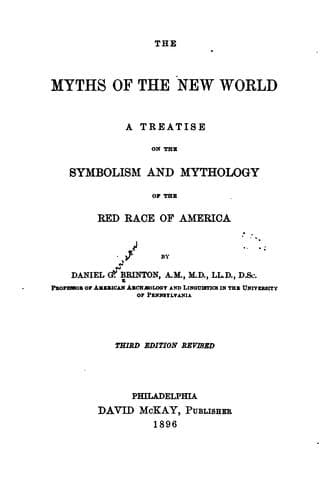
The Myths of the New World: A Treatise on the Symbolism and Mythology of the Red Race of AmericaBrinton, Daniel G. (Daniel Garrison)
Religion
The Myths of the New World: A Treatise on the Symbolism and Mythology of the Red Race of America
Brinton, Daniel G. (Daniel Garrison)
Indian mythology; Indians -- Folklore
indisputable authority, sets forth in its true light the belief of the
red race in a resurrection. It is not possible to trace it out in the
subtleties with which theologians have surrounded it as a dogma. The
very attempt would be absurd. They never occurred to the Indian. He
thought that the soul now enjoying the delights of the happy hunting
grounds would some time return to the bones, take on flesh, and live
again. Such is precisely the much discussed statement that Garcilasso de
la Vega says he often heard from the native Peruvians. He adds that so
careful were they lest any of the body should be lost that they
preserved even the parings of their nails and clippings of the
hair.[260-1] In contradiction to this the writer Acosta has been quoted,
who says that the Peruvians embalmed their dead because they "had no
knowledge that the bodies should rise with the soul."[260-2] But,
rightly understood, this is a confirmation of La Vega's account. Acosta
means that the Christian doctrine of the body rising from the dust being
unknown to the Peruvians (which is perfectly true), they preserved the
body just as it was, so that the soul when it returned to earth, as all
expected, might not be at a loss for a house of flesh.
The notions thus entertained by the red race on the resurrection are
peculiar to it, and stand apart from those of any other. They did not
look for the second life to be either better or worse than the present
one; they regarded it neither as a reward nor a punishment to be sent
back to the world of the living; nor is there satisfactory evidence that
it was ever distinctly connected with a moral or physical theory of the
destiny of the universe, or even with their prevalent expectation of
recurrent epochs in the course of nature. It is true that a writer whose
personal veracity is above all doubt, Mr. Adam Hodgson, relates an
ancient tradition of the Choctaws, to the effect that the present world
will be consumed by a general conflagration, after which it will be
reformed pleasanter than it now is, and that then the spirits of the
dead will return to the bones in the bone mounds, flesh will knit
together their loose joints, and they shall again inhabit their ancient
territory.[261-1]
There was also a similar belief among the Eskimos. They said that in the
course of time the waters would overwhelm the land, purify it of the
blood of the dead, melt the icebergs, and wash away the steep rocks. A
wind would then drive off the waters, and the new land would be peopled
by reindeers and young seals. Then would He above blow once on the bones
of the men and twice on those of the women, whereupon they would at once
start into life, and lead thereafter a joyous existence.[261-2]
Public-domain text, read in full here on John Shaqi.
Reviews
Reviews
No reviews yet
Be the first to share your thoughts on this work.
Elsewhere in the archive
Join the Discussion
Join the discussion
Sign in to leave a comment or review.
Sign InorCreate an account