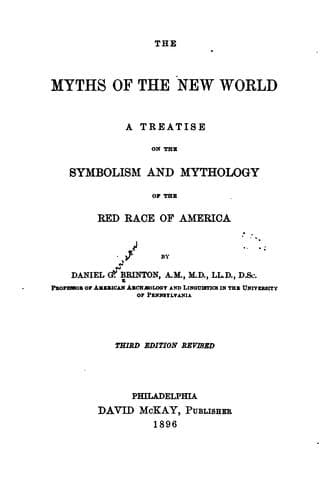
The Myths of the New World: A Treatise on the Symbolism and Mythology of the Red Race of AmericaBrinton, Daniel G. (Daniel Garrison)
Religion
The Myths of the New World: A Treatise on the Symbolism and Mythology of the Red Race of America
Brinton, Daniel G. (Daniel Garrison)
Indian mythology; Indians -- Folklore
At the appointed hour the whole village, together with
the incredulous Englishman, was on the beach, and sure enough, at the
minute specified, a canoe swung round a distant point of land, and
rapidly approaching the shore brought the expected news.[270-1]
Charlevoix is nearly as trustworthy a writer as Carver. Yet he
deliberately relates an equally singular instance.[270-2]
But these examples are surpassed by one described in the _Atlantic
Monthly_ of July, 1866, the author of which, John Mason Brown, Esq., has
assured me of its accuracy in every particular. Some years since, at the
head of a party of voyageurs, he set forth in search of a band of
Indians somewhere on the vast plains along the tributaries of the
Copper-mine and Mackenzie rivers. Danger, disappointment, and the
fatigues of the road, induced one after another to turn back, until of
the original ten only three remained. They also were on the point of
giving up the apparently hopeless quest, when they were met by some
warriors of the very band they were seeking. These had been sent out by
one of their medicine men to find three whites, whose horses, arms,
attire, and personal appearance he minutely described, which description
was repeated to Mr. Brown by the warriors before they saw his two
companions. When afterwards, the priest, a frank and simple-minded man,
was asked to explain this extraordinary occurrence, he could offer no
other explanation than that "he saw them coming, and heard them talk on
their journey."[271-1]
Many tales such as these have been recorded by travellers, and however
much they may shock our sense of probability, as well-authenticated
exhibitions of a power which sways the Indian mind, and which has ever
prejudiced it so unchangeably against Christianity and civilization,
they cannot be disregarded. Whether they too are but specimens of
refined knavery, whether they are instigations of the Devil, or whether
they must be classed with other facts as illustrating certain obscure
and curious mental faculties, each may decide as the bent of his mind
inclines him, for science makes no decision.
Those nervous conditions associated with the name of Mesmer were nothing
new to the Indian magicians. Rubbing and stroking the sick, and the
laying on of hands, were very common parts of their clinical procedures,
and at the initiations to their societies they were frequently
exhibited. Observers have related that among the Nez Percés of Oregon,
the novice was put to sleep by songs, incantations, and "certain passes
of the hand," and that with the Dakotas he would be struck lightly on
the breast at a preconcerted moment, and instantly "would drop prostrate
on his face, his muscles rigid and quivering in every fibre."[272-1]
Public-domain text, read in full here on John Shaqi.
Reviews
Reviews
No reviews yet
Be the first to share your thoughts on this work.
Elsewhere in the archive
Join the Discussion
Join the discussion
Sign in to leave a comment or review.
Sign InorCreate an account