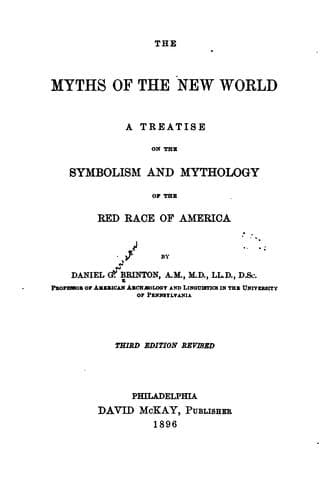
The Myths of the New World: A Treatise on the Symbolism and Mythology of the Red Race of AmericaBrinton, Daniel G. (Daniel Garrison)
Religion
The Myths of the New World: A Treatise on the Symbolism and Mythology of the Red Race of America
Brinton, Daniel G. (Daniel Garrison)
Indian mythology; Indians -- Folklore
There is no occasion to suppose deceit in this. It finds its parallel in
every race and every age, and rests on a characteristic trait of certain
epochs and certain men, which leads them to seek the divine, not in
thoughtful contemplation on the laws of the universe and the facts of
self-consciousness, but in an entire immolation of the latter, a sinking
of their own individuality in that of the spirits whose alliance they
seek. This is an outgrowth of that ignoring of the universality of Law,
which belongs to the lower stages of enlightenment.[273-1] And as this
is never done with impunity, but with iron certainty brings its
punishment with it, the study of the mental conditions thus evoked, and
the results which follow them, offers a salutary subject of reflection
to the theologian as well as the physician. For these examples of
nervous pathology are identical in kind, and alike in consequences,
whether witnessed in the primitive forests of the New World, among the
convulsionists of St. Medard, or in the excited scenes of a religious
revival in one of our own churches.
Sleeplessness and abstemiousness, carried to the utmost verge of human
endurance--seclusion, and the pertinacious fixing of the mind on one
subject--obstinate gloating on some morbid fancy, rarely failed to bring
about hallucinations with all the garb of reality. Physicians are well
aware that the more frequently these diseased conditions of the mind are
sought, the more readily they are found. Then, again, they were often
induced by intoxicating and narcotic herbs. Tobacco, the maguey, coca;
in California the chucuaco; among the Mexicans the snake plant,
ollinhiqui or coaxihuitl; and among the southern tribes of our own
country the cassine yupon and iris versicolor,[273-2] were used; and, it
is even said, were cultivated for this purpose. The seer must work
himself up to a prophetic fury, or speechless lie in apparent death
before the mind of the gods would be opened to him. Trance and ecstasy
were the two avenues he knew to divinity; fasting and seclusion the
means employed to discover them. His ideal was of a prophet who dwelt
far from men, without need of food, in constant communion with divinity.
Such an one, in the legends of the Tupis, resided on a mountain
glittering with gold and silver, near the river Uaupe, his only
companion a dog, his only occupation dreaming of the gods. When,
however, an eclipse was near, his dog would bark; and then, taking the
form of a bird, he would fly over the villages, and learn the changes
that had taken place.[274-1]
Public-domain text, read in full here on John Shaqi.
Reviews
Reviews
No reviews yet
Be the first to share your thoughts on this work.
Elsewhere in the archive
Join the Discussion
Join the discussion
Sign in to leave a comment or review.
Sign InorCreate an account