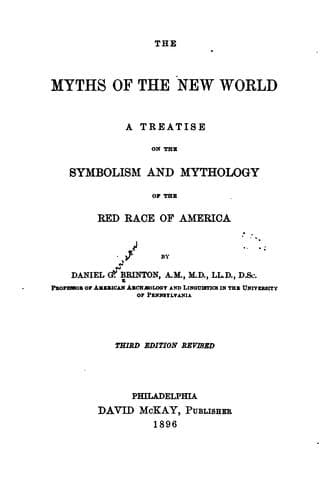
The Myths of the New World: A Treatise on the Symbolism and Mythology of the Red Race of AmericaBrinton, Daniel G. (Daniel Garrison)
Religion
The Myths of the New World: A Treatise on the Symbolism and Mythology of the Red Race of America
Brinton, Daniel G. (Daniel Garrison)
Indian mythology; Indians -- Folklore
Occasionally, in very uncultivated tribes, some family or totem claimed
a monopoly of the priesthood. Thus, among the Nez Percès of Oregon, it
was transmitted in one family from father to son and daughter, but
always with the proviso that the children at the proper age reported
dreams of a satisfactory character.[281-2] Perhaps alone of the Algonkin
tribes the Shawnees confined it to one totem, but it is remarkable that
the greatest of their prophets, Elskataway, brother of Tecumseh, was not
a member of this clan. From the most remote times, the Cherokees have
had one family set apart for the priestly office. This was when first
known to the whites that of the Nicotani, but its members, puffed up
with pride and insolence, abused their birthright so shamefully, and
prostituted it so flagrantly to their own advantage, that with savage
justice they were massacred to the last man. Another was appointed in
their place who to this day officiates in all religious rites. They
have, however, the superstition, possibly borrowed from Europeans, that
the _seventh_ son is a natural born prophet, with the gift of healing by
touch.[281-3] Adair states that their former neighbors, the Choctaws,
permitted the office of high priest, or Great Beloved Man, to remain in
one family, passing from father to eldest son, and the very influential
_piaches_ of the Carib tribes very generally transmitted their rank and
position to their children.
In ancient Anahuac the prelacy was as systematic and its rules as well
defined, as in the Church of Rome. Except those in the service of
Huitzilopochtli, and perhaps a few other gods, none obtained the
priestly office by right of descent, but were dedicated to it from early
childhood. Their education was completed at the _Calmecac_, a sort of
ecclesiastical college, where instruction was given in all the wisdom of
the ancients, and the esoteric lore of their craft. The art of mixing
colors and tracing designs, the ideographic writing and phonetic
hieroglyphs, the songs and prayers used in public worship, the national
traditions and the principles of astrology, the hidden meaning of
symbols and the use of musical instruments, all formed parts of the
really extensive course of instruction they there received. When they
manifested a satisfactory acquaintance with this curriculum, they were
appointed by their superiors to such positions as their natural talents
and the use they had made of them qualified them for, some to instruct
children, others to the service of the temples, and others again to take
charge of what we may call country parishes. Implicit subordination of
all to the high priest of Huitzilopochtli, hereditary _pontifex
maximus_, chastity, or at least temperate indulgence in pleasure,
gravity of carriage, and strict attention to duty, were laws laid upon
all.
Public-domain text, read in full here on John Shaqi.
Reviews
Reviews
No reviews yet
Be the first to share your thoughts on this work.
Elsewhere in the archive
Join the Discussion
Join the discussion
Sign in to leave a comment or review.
Sign InorCreate an account