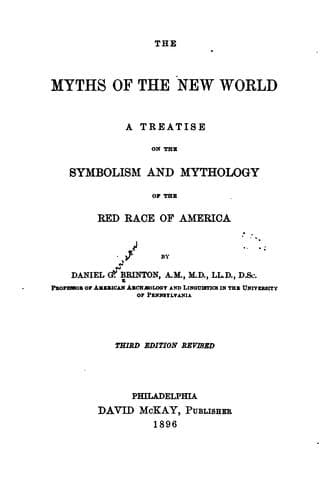
The Myths of the New World: A Treatise on the Symbolism and Mythology of the Red Race of AmericaBrinton, Daniel G. (Daniel Garrison)
Religion
The Myths of the New World: A Treatise on the Symbolism and Mythology of the Red Race of America
Brinton, Daniel G. (Daniel Garrison)
Indian mythology; Indians -- Folklore
How was this superior power obtained? What were the terms of admission
to this privileged class? In the ruder communities the power was
strictly personal. It was revealed to its possessor by the character of
the visions he perceived at the ordeal he passed through on arriving at
puberty; and by the northern nations was said to be the manifestation of
a more potent personal spirit than ordinary. It was not a faculty, but
an inspiration; not an inborn strength, but a spiritual gift. The
curious theory of the Dakotas, as recorded by the Rev. Mr. Pond, was
that the necromant first wakes to consciousness as a winged seed, wafted
hither and thither by the intelligent action of the Four Winds. In this
form he visits the homes of the different classes of divinities, and
learns the chants, feasts, and dances, which it is proper for the human
race to observe, the art of omnipresence or clairvoyance, the means of
inflicting and healing diseases, and the occult secrets of nature, man,
and divinity. This is called "dreaming of the gods." When this
instruction is completed, the seed enters one about to become a mother,
assumes human form, and in due time manifests his powers. _Four_ such
incarnations await it, each of increasing might, and then the spirit
returns to its original nothingness. The same necessity of death and
resurrection was entertained by the Eskimos. To become of the highest
order of priests, it was supposed requisite, says Bishop Egede, that one
of the lower order should be drowned and eaten by sea monsters. Then,
when his bones, one after another, were all washed ashore, his spirit,
which meanwhile had been learning the secrets of the invisible world,
would return to them, and, clothed in flesh, he would go back to his
tribe. At other times a vague and indescribable longing seizes a young
person, a morbid appetite possesses them, or they fall a prey to an
inappeasable and aimless restlessness, or a causeless melancholy. These
signs the old priests recognize as the expression of a personal spirit
of the higher order. They take charge of the youth, and educate him to
the mysteries of their craft. For months or years he is condemned to
entire seclusion, receiving no visits but from the brethren of his
order. At length he is initiated with ceremonies of more or less pomp
into the brotherhood, and from that time assumes that gravity of
demeanor, sententious style of expression, and general air of mystery
and importance, everywhere deemed so eminently becoming in a doctor and
a priest. A peculiarity of the Moxos was, that they thought none
designated for the office but such as had escaped from the claws of the
South American tiger, which, indeed, it is said they worshipped as a
god.[281-1]
Public-domain text, read in full here on John Shaqi.
Reviews
Reviews
No reviews yet
Be the first to share your thoughts on this work.
Elsewhere in the archive
Join the Discussion
Join the discussion
Sign in to leave a comment or review.
Sign InorCreate an account