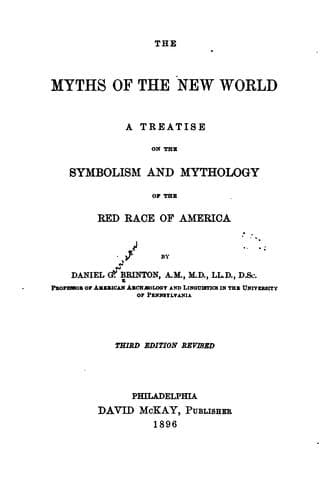
The Myths of the New World: A Treatise on the Symbolism and Mythology of the Red Race of AmericaBrinton, Daniel G. (Daniel Garrison)
Religion
The Myths of the New World: A Treatise on the Symbolism and Mythology of the Red Race of America
Brinton, Daniel G. (Daniel Garrison)
Indian mythology; Indians -- Folklore
Nearly all the remains of American plastic art, sculpture, and painting,
were obviously designed for religious purposes. Idols of stone, wood, or
baked clay, were found in every Indian tribe, without exception, so far
as I can judge; and in only a few directions do these arts seem to have
been applied to secular purposes. The most ambitious attempts of
architecture, it is plain, were inspired by religious fervor. The great
pyramid of Cholula, the enormous mounds of the Mississippi valley, the
elaborate edifices on artificial hills in Yucatan, were miniature
representations of the mountains hallowed by tradition, the "Hill of
Heaven," the peak on which their ancestors escaped in the flood, or that
in the terrestrial paradise from which flow the rains. Their
construction took men away from war and the chase, encouraged
agriculture, peace, and a settled disposition, and fostered the love of
property, of country, and of the gods. The priests were also close
observers of nature, and were the first to discover its simpler laws.
The Aztec sages were as devoted star-gazers as the Chaldeans, and their
calendar bears unmistakable marks of native growth, and of its original
purpose to fix the annual festivals. Writing by means of pictures and
symbols was cultivated chiefly for religious ends, and the word
_hieroglyph_ is a witness that the phonetic alphabet was discovered
under the stimulus of the religious sentiment. Most of the aboriginal
literature was composed and taught by the priests, and most of it refers
to matters connected with their superstitions. As the gifts of votaries
and the erection of temples enriched the sacerdotal order individually
and collectively, the terrors of religion were lent to the secular arm
to enforce the rights of property. Music, poetic, scenic, and historical
recitations, formed parts of the ceremonies of the more civilized
nations, and national unity was strengthened by a common shrine. An
active barter in amulets, lucky stones, and charms, existed all over the
continent, to a much greater extent than we might think. As experience
demonstrates that nothing so efficiently promotes civilization as the
free and peaceful intercourse of man with man, I lay particular stress
on the common custom of making pilgrimages.
Public-domain text, read in full here on John Shaqi.
Reviews
Reviews
No reviews yet
Be the first to share your thoughts on this work.
Elsewhere in the archive
Join the Discussion
Join the discussion
Sign in to leave a comment or review.
Sign InorCreate an account