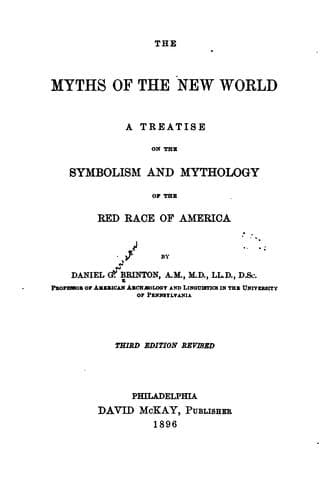
The Myths of the New World: A Treatise on the Symbolism and Mythology of the Red Race of AmericaBrinton, Daniel G. (Daniel Garrison)
Religion
The Myths of the New World: A Treatise on the Symbolism and Mythology of the Red Race of America
Brinton, Daniel G. (Daniel Garrison)
Indian mythology; Indians -- Folklore
The temple on the island of Cozumel in Yucatan was visited every year by
such multitudes from all parts of the peninsula, that roads, paved with
cut stones, had been constructed from the neighboring shore to the
principal cities of the interior.[302-1] Each village of the Muyscas is
said to have had a beaten path to Lake Guatavita, so numerous were the
devotees who journeyed to the shrine there located.[302-2] In Peru the
temples of Pachacamà, Rimac, and other famous gods, were repaired to by
countless numbers from all parts of the realm, and from other provinces
within a radius of three hundred leagues around. Houses of entertainment
were established on all the principal roads, and near the temples, for
their accommodation; and when they made known the object of their
journey, they were allowed a safe passage even through an enemy's
territory.[302-3]
* * * * *
The more carefully we study history, the more important in our eyes will
become the religious sense. It is almost the only faculty peculiar to
man. It concerns him nearer than aught else. It is the key to his origin
and destiny. As such it merits in all its developments the most earnest
attention, an attention we shall find well repaid in the clearer
conceptions we thus obtain of the forces which control the actions and
fates of individuals and nations.
FOOTNOTES:
[288-1] Waitz, _Anthropologie der Naturvoelker_, i. p. 459.
[288-2] Navarrete, _Viages_, iii. p. 415.
[288-3] _Relation de Cueba_, p. 140. Ed. Ternaux-Compans.
[290-1] La Vega, _Hist. des Incas_, liv. v. cap. 12.
[291-1] Morse, _Rep. on the Ind. Tribes_, App. p. 345.
[291-2] Ximenes, _Origen de los Indios de Guatemala_, p. 192; Acosta,
_Hist. of the New World_, lib. v. chap. 18.
[291-3] Joseph de Maistre, _Eclaircissement sur les Sacrifices_; Trench,
_Hulsean Lectures_, p. 180. The famed Abbé Lammenaais and Professor Sepp,
of Munich, with these two writers, may be taken as the chief exponents of
a school of mythologists, all of whom start from the theories first laid
down by Count de Maistre in his _Soirées de St. Petersbourg_. To them the
strongest proof of Christianity lies in the traditions and observances of
heathendom. For these show the wants of the religious sense, and
Christianity, they maintain, purifies and satisfies them all. The rites,
symbols, and legends of every natural religion, they say, are true and
not false; all that is required is to assign them their proper places and
their real meaning. Therefore the strange resemblances in heathen myths
to what is revealed in the Scriptures, as well as the ethical
anticipations which have been found in ancient philosophies, all, so far
from proving that Christianity is a natural product of the human mind, in
fact, are confirmations of it, unconscious prophecies, and presentiments
of the truth.
[292-1] Alfred Maury, _La Magie et l'Astrologie dans l'Antiquité et au
Moyen Age_, p. 8: Paris, 1860.
Public-domain text, read in full here on John Shaqi.
Reviews
Reviews
No reviews yet
Be the first to share your thoughts on this work.
Elsewhere in the archive
Join the Discussion
Join the discussion
Sign in to leave a comment or review.
Sign InorCreate an account