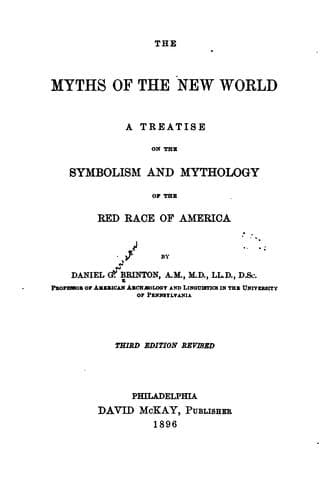
The Myths of the New World: A Treatise on the Symbolism and Mythology of the Red Race of AmericaBrinton, Daniel G. (Daniel Garrison)
Religion
The Myths of the New World: A Treatise on the Symbolism and Mythology of the Red Race of America
Brinton, Daniel G. (Daniel Garrison)
Indian mythology; Indians -- Folklore
Water the oldest element.--Its use in purification.--Holy water.--The
Rite of Baptism.--The Water of Life.--Its symbols.--The Vase.--The
Moon.--The latter the goddess of love and agriculture, but also of
sickness, night, and pain.--Often represented by a dog.--Fire worship
under the form of Sun worship.--The perpetual fire.--The new
fire.--Burning the dead.--A worship of the passions, but no sexual
dualism in myths, nor any phallic worship in America.--Synthesis of
the worship of Fire, Water, and the Winds in the THUNDER-STORM,
personified as Haokah, Tupa, Catequil, Contici, Heno, Tlaloc,
Mixcoatl, and other deities, many of them triune 122
CHAPTER VI.
THE SUPREME GODS OF THE RED RACE.
Analysis of American culture myths.--The Manibozho or Michabo of
the Algonkins shown to be an impersonation of LIGHT, a hero of the
Dawn, and their highest deity.--The myths of Ioskeha of the
Iroquois, Viracocha of the Peruvians, and Quetzalcoatl of the
Toltecs essentially the same as that of Michabo.--Other
examples.--Ante-Columbian prophecies of the advent of a white race
from the east as conquerors.--Rise of later culture myths under
similar forms 159
CHAPTER VII.
THE MYTHS OF THE CREATION, THE DELUGE, THE EPOCHS OF NATURE, AND THE
LAST DAY.
Cosmogonies usually portray the action of the SPIRIT on the
WATERS.--Those of the Muscogees, Athapascas, Quichés, Mixtecs,
Iroquois, Algonkins, and others.--The Flood-Myth an unconscious
attempt to reconcile a creation in time with the eternity of
matter.--Proof of this from American mythology.--Characteristics of
American Flood-Myths.--The person saved usually the first man.--The
number seven.--Their Ararats.--The rôle of birds.--The confusion of
tongues.--The Aztec, Quiché, Algonkin, Tupi, and earliest Sanscrit
flood-myths.--The belief in Epochs of Nature a further result of this
attempt at reconciliation.--Its forms among Peruvians, Mayas, and
Aztecs.--The expectation of the End of the World a corollary of this
belief.--Views of various nations 193
CHAPTER VIII.
THE ORIGIN OF MAN.
Usually man is the EARTH-BORN, both in language and
myths.--Illustrations from the legends of the Caribs, Apalachians,
Iroquois, Quichuas, Aztecs, and others.--The under-world.--Man the
product of one of the primal creative powers, the Spirit, or the
Water, in the myths of the Athapascas, Eskimos, Moxos, and
others--Never literally derived from an inferior species 222
CHAPTER IX.
THE SOUL AND ITS DESTINY.
Public-domain text, read in full here on John Shaqi.
Reviews
Reviews
No reviews yet
Be the first to share your thoughts on this work.
Join the Discussion
Join the discussion
Sign in to leave a comment or review.
Sign InorCreate an account