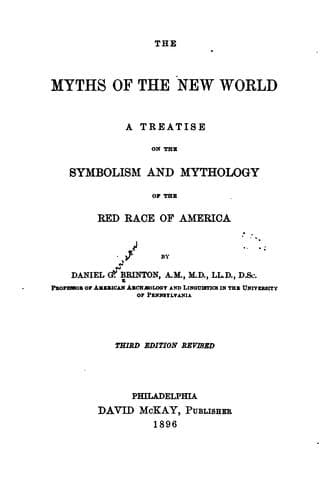
The Myths of the New World: A Treatise on the Symbolism and Mythology of the Red Race of America — John Shaqi
The Myths of the New World: A Treatise on the Symbolism and Mythology of the Red Race of AmericaBrinton, Daniel G. (Daniel Garrison)
Religion
The Myths of the New World: A Treatise on the Symbolism and Mythology of the Red Race of America
Brinton, Daniel G. (Daniel Garrison)
Indian mythology; Indians -- Folklore
[29-1] According to Professor Buschmann Aztec is probably from _iztac_,
white, and Nahuatlacatl signifies those who speak the language _Nahuatl_,
clear sounding, sonorous. The Abbé Brasseur (de Bourbourg), on the other
hand, derives the latter from the Quiche _nawal_, intelligent, and adds
the amazing information that this is identical with the English _know
all_!! (_Hist. du Mexique_, etc., i. p. 102). For in his theory several
languages of Central America are derived from the same old Indo-Germanic
stock as the English, German, and cognate tongues. Toltec, from
_Toltecatl_, means inhabitant of Tollan, which latter may be from
_tolin_, rush, and signify the place of rushes. The signification
_artificer_, often assigned to Toltecatl, is of later date, and was
derived from the famed artistic skill of this early folk (Buschmann,
_Aztek. Ortsnamen_, p. 682: Berlin, 1852). The Toltecs are usually spoken
of as anterior to the Nahuas, but the Tlascaltecs and natives of
Cholollan or Cholula were in fact Toltecs, unless we assign to this
latter name a merely mythical signification. The early migrations of the
two Aztec bands and their relationship, it may be said in passing, are as
yet extremely obscure. The Shoshonees when first known dwelt as far north
as the head waters of the Missouri, and in the country now occupied by
the Black Feet. Their language, which includes that of the Comanche,
Wihinasht, Utah, and kindred bands, was first shown to have many and
marked affinities with that of the Aztecs by Professor Buschmann in his
great work, _Ueber die Spuren der Aztekischen Sprache im nördlichen
Mexico und höheren Amerikanischen Norden_, p. 648: Berlin, 1854.
[31-1] His opinion was founded on an analysis of fifteen words of the
secret language of the Incas preserved in the Royal Commentaries of
Garcilasso de la Vega. On examination, they all proved to be modified
forms from the _lengua general_ (Meyen, _Ueber die Ureinwohner von Peru_,
p. 6). The Quichuas of Peru must not be confounded with the Quiches of
Guatemala. Quiche is the name of a place, and means "many trees;" the
derivation of Quichua is unknown. Muyscas means "men." This nation also
called themselves Chibchas.
[32-1] The significance of Carib is probably warrior. It may be the same
word as Guarani, which also has this meaning. Tupi or Tupa is the name
given the thunder, and can only be understood mythically.
[33-1] The Araucanians probably obtained their name from two Quichua
words, _ari auccan_, yes! they fight; an idiom very expressive of their
warlike character. They had had long and terrible wars with the Incas
before the arrival of Pizarro.
Public-domain text, read in full here on John Shaqi.
Reviews
Reviews
No reviews yet
Be the first to share your thoughts on this work.
Join the Discussion
Join the discussion
Sign in to leave a comment or review.
Sign InorCreate an account