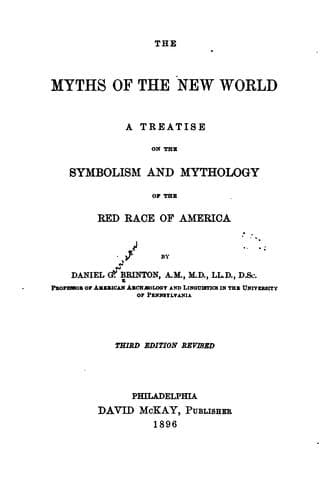
The Myths of the New World: A Treatise on the Symbolism and Mythology of the Red Race of AmericaBrinton, Daniel G. (Daniel Garrison)
Religion
The Myths of the New World: A Treatise on the Symbolism and Mythology of the Red Race of America
Brinton, Daniel G. (Daniel Garrison)
Indian mythology; Indians -- Folklore
The Aztec priests never chanted more regretful dirges than when they
sang of Tulan, the cradle of their race, where once it dwelt in peaceful
indolent happiness, whose groves were filled with birds of sweet voices
and gay plumage, whose generous soil brought forth spontaneously maize,
cocoa, aromatic gums, and fragrant flowers. "Land of riches and plenty,
where the gourds grow an arm's length across, where an ear of corn is a
load for a stout man, and its stalks are as high as trees; land where
the cotton ripens of its own accord of all rich tints; land abounding
with limpid emeralds, turquoises, gold, and silver."[88-1] This land was
also called Tlalocan, from Tlaloc, the god of rain, who there had his
dwelling place, and Tlapallan, the land of colors, or the red land, for
the hues of the sky at sunrise floated over it. Its inhabitants were
surnamed children of the air, or of Quetzalcoatl, and from its centre
rose the holy mountain Tonacatepec, the mountain of our life or
subsistence. Its supposed location was in the east, whence in that
country blow the winds that bring mild rains, says Sahagun, and that
missionary was himself asked, as coming from the east, whether his home
was in Tlapallan; more definitely by some it was situated among the
lofty peaks on the frontiers of Guatemala, and all the great rivers that
water the earth were supposed to have their sources there.[88-2] But
here, as elsewhere, its site was not determined. "There is a Tulan,"
says an ancient authority, "where the sun rises, and there is another in
the land of shades, and another where the sun reposes, and thence came
we; and still another where the sun reposes, and there dwells
God."[89-1]
The myth of the Quichés but changes the name of this pleasant land. With
them it was _Pan-paxil-pa-cayala_, where the waters divide in falling,
or between the waters parcelled out and mucky. This was "an excellent
land, full of pleasant things, where was store of white corn and yellow
corn, where one could not count the fruits, nor estimate the quantity of
honey and food." Over it ruled the lord of the air, and from it the
four sacred animals carried the corn to make the flesh of men.[90-1]
Public-domain text, read in full here on John Shaqi.
Reviews
Reviews
No reviews yet
Be the first to share your thoughts on this work.
Join the Discussion
Join the discussion
Sign in to leave a comment or review.
Sign InorCreate an account