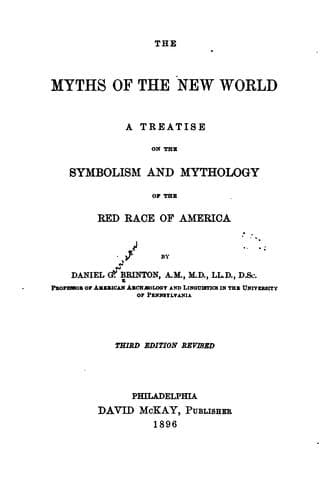
The Myths of the New World: A Treatise on the Symbolism and Mythology of the Red Race of America — John Shaqi
The Myths of the New World: A Treatise on the Symbolism and Mythology of the Red Race of AmericaBrinton, Daniel G. (Daniel Garrison)
Religion
The Myths of the New World: A Treatise on the Symbolism and Mythology of the Red Race of America
Brinton, Daniel G. (Daniel Garrison)
Indian mythology; Indians -- Folklore
From this direction came, according to the almost unanimous opinion of
the Indian tribes, those hero gods who taught them arts and religion,
thither they returned, and from thence they would again appear to resume
their ancient sway. As the dawn brings light, and with light is
associated in every human mind the ideas of knowledge, safety,
protection, majesty, divinity, as it dispels the spectres of night, as
it defines the cardinal points, and brings forth the sun and the day,
it occupied the primitive mind to an extent that can hardly be magnified
beyond the truth. It is in fact the central figure in most natural
religions.
The west, as the grave of the heavenly luminaries, or rather as their
goal and place of repose, brings with it thoughts of sleep, of death, of
tranquillity, of rest from labor. When the evening of his days was come,
when his course was run, and man had sunk from sight, he was supposed to
follow the sun and find some spot of repose for his tired soul in the
distant west. There, with general consent, the tribes north of the Gulf
of Mexico supposed the happy hunting grounds; there, taught by the same
analogy, the ancient Aryans placed the Nerriti, the exodus, the land of
the dead. "The old notion among us," said on one occasion a
distinguished chief of the Creek nation, "is that when we die, the
spirit goes the way the sun goes, to the west, and there joins its
family and friends who went before it."[92-1]
In the northern hemisphere the shadows fall to the north, thence blow
cold and furious winds, thence come the snow and early thunder. Perhaps
all its primitive inhabitants, of whatever race, thought it the seat of
the mighty gods.[92-2] A floe of ice in the Arctic Sea was the home of
the guardian spirit of the Algonkins;[92-3] on a mountain near the north
star the Dakotas thought Heyoka dwelt who rules the seasons; and the
realm of Mictla, the Aztec god of death, lay where the shadows pointed.
From that cheerless abode his sceptre reached over all creatures, even
the gods themselves, for sooner or later all must fall before him. The
great spirit of the dead, said the Ottawas, lives in the dark
north,[93-1] and there, in the opinion of the Monquis of California,
resided their chief god, Gumongo.[93-2]
Public-domain text, read in full here on John Shaqi.
Reviews
Reviews
No reviews yet
Be the first to share your thoughts on this work.
Join the Discussion
Join the discussion
Sign in to leave a comment or review.
Sign InorCreate an account