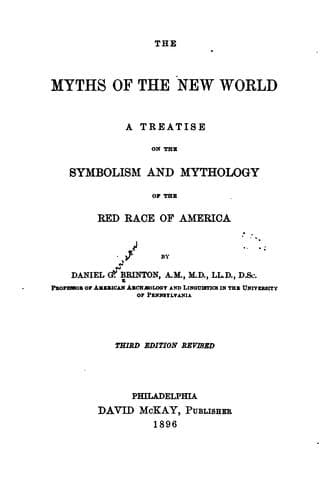
The Myths of the New World: A Treatise on the Symbolism and Mythology of the Red Race of AmericaBrinton, Daniel G. (Daniel Garrison)
Religion
The Myths of the New World: A Treatise on the Symbolism and Mythology of the Red Race of America
Brinton, Daniel G. (Daniel Garrison)
Indian mythology; Indians -- Folklore
Sometimes some particular species seems to have been chosen as most
befitting these dignified attributes. No citizen of the United States
will be apt to assert that their instinct led the indigenes of our
territory astray when they chose with nigh unanimous consent the great
American eagle as that fowl beyond all others proper to typify the
supreme control and the most admirable qualities. Its feathers composed
the war flag of the Creeks, and its images carved in wood or its stuffed
skin surmounted their council lodges (Bartram); none but an approved
warrior dare wear it among the Cherokees (Timberlake); and the Dakotas
allowed such an honor only to him who had first touched the corpse of
the common foe (De Smet). The Natchez and Akanzas seem to have paid it
even religious honors, and to have installed it in their most sacred
shrines (Sieur de Tonty, Du Pratz); and very clearly it was not so much
for ornament as for a mark of dignity and a recognized sign of worth
that its plumes were so highly prized. The natives of Zuñi, in New
Mexico, employed four of its feathers to represent the four winds in
their invocations for rain (Whipple), and probably it was the eagle
which a tribe in Upper California (the Acagchemem) worshipped under the
name Panes. Father Geronimo Boscana describes it as a species of
vulture, and relates that one of them was immolated yearly, with solemn
ceremony, in the temple of each village. Not a drop of blood was
spilled, and the body burned. Yet with an amount of faith that staggered
even the Romanist, the natives maintained and believed that it was the
same individual bird they sacrificed each year; more than this, that the
same bird was slain by each of the villages![105-1]
The owl was regarded by Aztecs, Quichés, Mayas, Peruvians, Araucanians,
and Algonkins as sacred to the lord of the dead. "The Owl" was one of
the names of the Mexican Pluto, whose realm was in the north,[106-1] and
the wind from that quarter was supposed by the Chipeways to be made by
the owl as the south by the butterfly.[106-2] As the bird of night, it
was the fit emissary of him who rules the darkness of the grave.
Something in the looks of the creature as it sapiently stares and blinks
in the light, or perhaps that it works while others sleep, got for it
the character of wisdom. So the Creek priests carried with them as the
badge of their learned profession the stuffed skin of one of these
birds, thus modestly hinting their erudite turn of mind,[106-3] and the
culture hero of the Monquis of California was represented, like Pallas
Athene, having one as his inseparable companion (Venegas).
Public-domain text, read in full here on John Shaqi.
Reviews
Reviews
No reviews yet
Be the first to share your thoughts on this work.
Join the Discussion
Join the discussion
Sign in to leave a comment or review.
Sign InorCreate an account