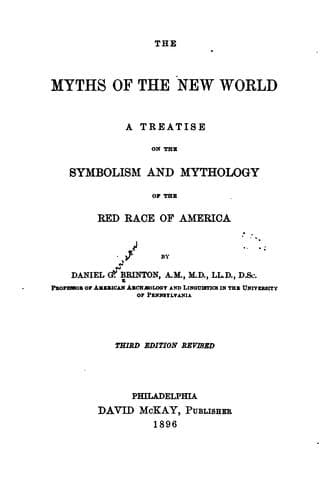
The Myths of the New World: A Treatise on the Symbolism and Mythology of the Red Race of AmericaBrinton, Daniel G. (Daniel Garrison)
Religion
The Myths of the New World: A Treatise on the Symbolism and Mythology of the Red Race of America
Brinton, Daniel G. (Daniel Garrison)
Indian mythology; Indians -- Folklore
As the associate of the god of light and air, and as the antithesis
therefore of the owl, the Aztecs reverenced a bird called _quetzal_,
which I believe is a species of parroquet. Its plumage is of a bright
green hue, and was prized extravagantly as a decoration. It was one of
the symbols and part of the name of Quetzalcoatl, their mythical
civilizer, and the prince of all sorts of singing birds, myriads of whom
were fabled to accompany him on his journeys.
The tender and hallowed associations that have so widely shielded the
dove from harm, which for instance Xenophon mentions among the ancient
Persians, were not altogether unknown to the tribes of the New World.
Neither the Hurons nor Mandans would kill them, for they believed they
were inhabited by the souls of the departed,[107-1] and it is said, but
on less satisfactory authority, that they enjoyed similar immunity among
the Mexicans. Their soft and plaintive note and sober russet hue widely
enlisted the sympathy of man, and linked them with his more tender
feelings.
"As wise as the serpent, as harmless as the dove," is an antithesis that
might pass current in any human language. They are the emblems of
complementary, often contrasted qualities. Of all animals, the serpent
is the most mysterious. No wonder it possessed the fancy of the
observant child of nature. Alone of creatures it swiftly progresses
without feet, fins, or wings. "There be three things which are too
wonderful for me, yea, four which I know not," said wise King Solomon;
and the chief of them were, "the way of an eagle in the air, the way of
a serpent upon a rock."
Its sinuous course is like to nothing so much as that of a winding
river, which therefore we often call serpentine. So did the Indians.
Kennebec, a stream in Maine, in the Algonkin means snake, and Antietam,
the creek in Maryland of tragic celebrity, in an Iroquois dialect has
the same significance. How easily would savages, construing the figure
literally, make the serpent a river or water god! Many species being
amphibious would confirm the idea. A lake watered by innumerable
tortuous rills wriggling into it, is well calculated for the fabled
abode of the king of the snakes. Thus doubtless it happened that both
Algonkins and Iroquois had a myth that in the great lakes dwelt a
monster serpent, of irascible temper, who unless appeased by meet
offerings raised a tempest or broke the ice beneath the feet of those
venturing on his domain, and swallowed them down.[108-1]
Public-domain text, read in full here on John Shaqi.
Reviews
Reviews
No reviews yet
Be the first to share your thoughts on this work.
Elsewhere in the archive
Join the Discussion
Join the discussion
Sign in to leave a comment or review.
Sign InorCreate an account