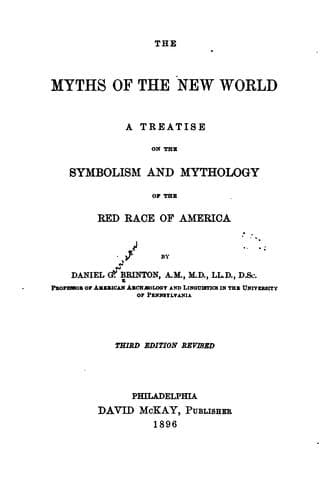
The Myths of the New World: A Treatise on the Symbolism and Mythology of the Red Race of AmericaBrinton, Daniel G. (Daniel Garrison)
Religion
The Myths of the New World: A Treatise on the Symbolism and Mythology of the Red Race of America
Brinton, Daniel G. (Daniel Garrison)
Indian mythology; Indians -- Folklore
The rattlesnake was the species almost exclusively honored by the red
race. It is slow to attack, but venomous in the extreme, and possesses
the power of the basilisk to attract within reach of its spring small
birds and squirrels. Probably this much talked of fascination is nothing
more than by its presence near their nests to incite them to attack, and
to hazard near and nearer approaches to their enemy in hope to force him
to retreat, until once within the compass of his fell swoop they fall
victims to their temerity. I have often watched a cat act thus. Whatever
explanation may be received, the fact cannot be questioned, and is ever
attributed by the unreflecting, to some diabolic spell cast upon them by
the animal. They have the same strange susceptibility to the influence
of certain sounds as the vipers, in which lies the secret of snake
charming. Most of the Indian magicians were familiar with this
singularity. They employed it with telling effect to put beyond question
their intercourse with the unseen powers, and to vindicate the potency
of their own guardian spirits who thus enabled them to handle with
impunity the most venomous of reptiles.[109-1] The well-known antipathy
of these serpents to certain plants, for instance the hazel, which bound
around the ankles is an efficient protection against their attacks, and
perhaps some antidote to their poison used by the magicians, led to
their frequent introduction in religious ceremonies. Such exhibitions
must have made a profound impression on the spectators, and redounded in
a corresponding degree to the glory of the performer. "Who is a manito?"
asks the mystic meda chant of the Algonkins. "He," is the reply, "he who
walketh with a serpent, walking on the ground, he is a manito."[109-2]
And the intimate alliance of this symbol with the most sacred mysteries
of religion, the darkest riddles of the Unknown, is reflected in their
language, and also in that of their neighbors the Dakotas, in both of
which the same words _manito_, _wakan_, which express divinity in its
broadest sense, are also used as generic terms signifying this species
of animals! This strange fact is not without a parallel, for in both
Arabic and Hebrew, the word for serpent has many derivatives, meaning to
have intercourse with demoniac powers, to practise magic, and to consult
familiar spirits.[110-1]
Public-domain text, read in full here on John Shaqi.
Reviews
Reviews
No reviews yet
Be the first to share your thoughts on this work.
Elsewhere in the archive
Join the Discussion
Join the discussion
Sign in to leave a comment or review.
Sign InorCreate an account