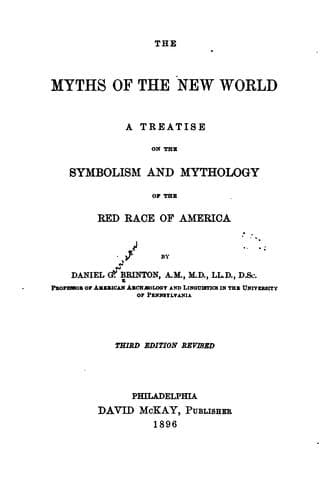
The Myths of the New World: A Treatise on the Symbolism and Mythology of the Red Race of AmericaBrinton, Daniel G. (Daniel Garrison)
Religion
The Myths of the New World: A Treatise on the Symbolism and Mythology of the Red Race of America
Brinton, Daniel G. (Daniel Garrison)
Indian mythology; Indians -- Folklore
The pious founder of the Moravian brotherhood, the Count of Zinzendorf,
owed his life on one occasion to this deeply rooted superstition. He was
visiting a missionary station among the Shawnees, in the Wyoming valley.
Recent quarrels with the whites had unusually irritated this unruly
folk, and they resolved to make him their first victim. After he had
retired to his secluded hut, several of their braves crept upon him, and
cautiously lifting the corner of the lodge, peered in. The venerable man
was seated before a little fire, a volume of the Scriptures on his
knees, lost in the perusal of the sacred words. While they gazed, a huge
rattlesnake, unnoticed by him, trailed across his feet, and rolled
itself into a coil in the comfortable warmth of the fire. Immediately
the would-be murderers forsook their purpose and noiselessly retired,
convinced that this was indeed a man of God.
A more unique trait than any of these is its habit of casting its skin
every spring, thus as it were renewing its life. In temperate latitudes
the rattlesnake, like the leaves and flowers, retires from sight during
the cold season, and at the return of kindly warmth puts on a new and
brilliant coat. Its cast-off skin was carefully collected by the savages
and stored in the medicine bag as possessing remedial powers of high
excellence. Itself thus immortal, they thought it could impart its
vitality to them. So when the mother was travailing in sore pain, and
the danger neared that the child would be born silent, the attending
women hastened to catch some serpent and give her its blood to
drink.[111-1]
It is well known that in ancient art this animal was the symbol of
Æsculapius, and to this day, Professor Agassiz found that the Maues
Indians, who live between the upper Tapajos and Madeira Rivers in
Brazil, whenever they assign a form to any "remedio," give it that of a
serpent.[111-2]
Probably this notion that it was annually rejuvenated led to its
adoption as a symbol of Time among the Aztecs; or, perchance, as they
reckoned by suns, and the figure of the sun, a circle, corresponds to
nothing animate but a serpent with its tail in its mouth, eating itself,
as it were, this may have been its origin. Either of them is more likely
than that the symbol arose from the recondite reflection that time is
"never ending, still beginning, still creating, still destroying," as
has been suggested.
Public-domain text, read in full here on John Shaqi.
Reviews
Reviews
No reviews yet
Be the first to share your thoughts on this work.
Elsewhere in the archive
Join the Discussion
Join the discussion
Sign in to leave a comment or review.
Sign InorCreate an account