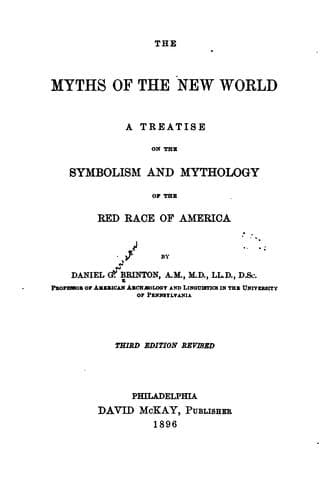
The Myths of the New World: A Treatise on the Symbolism and Mythology of the Red Race of AmericaBrinton, Daniel G. (Daniel Garrison)
Religion
The Myths of the New World: A Treatise on the Symbolism and Mythology of the Red Race of America
Brinton, Daniel G. (Daniel Garrison)
Indian mythology; Indians -- Folklore
When Father Buteux was a missionary among the Algonkins, in 1637, he
asked them their opinion of the nature of lightning. "It is an immense
serpent," they replied, "which the Manito is vomiting forth; you can see
the twists and folds that he leaves on the trees which he strikes; and
underneath such trees we have often found huge snakes." "Here is a novel
philosophy for you!" exclaims the Father.[113-2] So the Shawnees called
the thunder "the hissing of the great snake;"[113-3] and Tlaloc, the
Toltec thunder god, held in his hand a serpent of gold to represent the
lightning.[114-1] For this reason the Caribs spoke of the god of the
thunder storm as a great serpent dwelling in the fruit forests,[114-2]
and in the Quiché legends other names for Hurakan, the hurricane or
thunder-storm, are the Strong Serpent, He who hurls below, referring to
the lightning.[114-3]
Among the Hurons, in 1648, the Jesuits found a legend current that there
existed somewhere a monster serpent called Onniont, who wore on his head
a horn that pierced rocks, trees, hills, in short everything he
encountered. Whoever could get a piece of this horn was a fortunate man,
for it was a sovereign charm and bringer of good luck. The Hurons
confessed that none of them had had the good hap to find the monster and
break his horn, nor indeed had they any idea of his whereabouts; but
their neighbors, the Algonkins, furnished them at times small fragments
for a large consideration.[114-4] Clearly the myth had been taught them
for venal purposes by their trafficking visitors. Now among the
Algonkins, the Shawnee tribe did more than all others combined to
introduce and carry about religious legends and ceremonies. From the
earliest times they seem to have had peculiar aptitude for the
ecstasies, deceits, and fancies that made up the spiritual life of their
associates. Their constantly roving life brought them in contact with
the myths of many nations. And it is extremely probable that they first
brought the tale of the horned serpent from the Creeks and Cherokees. It
figured extensively in the legends of both these tribes.
The latter related that once upon a time among the glens of their
mountains dwelt the prince of rattlesnakes. Obedient subjects guarded
his palace, and on his head glittered in place of a crown a gem of
marvellous magic virtues. Many warriors and magicians tried to get
possession of this precious talisman, but were destroyed by the poisoned
fangs of its defenders. Finally, one more inventive than the rest hit
upon the bright idea of encasing himself in leather, and by this device
marched unharmed through the hissing and snapping court, tore off the
shining jewel, and bore it in triumph to his nation. They preserved it
with religious care, brought it forth on state occasions with solemn
ceremony, and about the middle of the last century, when Captain
Timberlake penetrated to their towns, told him its origin.[115-1]
Public-domain text, read in full here on John Shaqi.
Reviews
Reviews
No reviews yet
Be the first to share your thoughts on this work.
Elsewhere in the archive
Join the Discussion
Join the discussion
Sign in to leave a comment or review.
Sign InorCreate an account