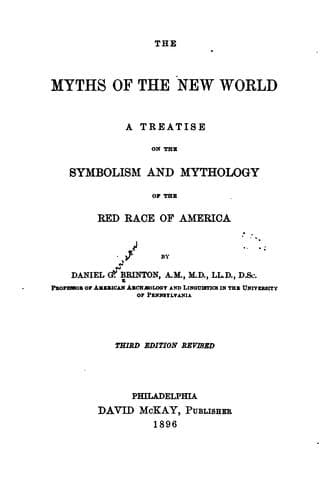
The Myths of the New World: A Treatise on the Symbolism and Mythology of the Red Race of AmericaBrinton, Daniel G. (Daniel Garrison)
Religion
The Myths of the New World: A Treatise on the Symbolism and Mythology of the Red Race of America
Brinton, Daniel G. (Daniel Garrison)
Indian mythology; Indians -- Folklore
The charm which the Creeks presented their young men when they set out
on the war path was of very similar character. It was composed of the
bones of the panther and the horn of the fabulous horned snake.
According to a legend taken down by an unimpeachable authority toward
the close of the last century, the great snake dwelt in the waters; the
old people went to the brink and sang the sacred songs. The monster rose
to the surface. The sages recommenced the mystic chants. He rose a
little out o[TN-3] the water. Again they repeated the songs. This time
he showed his horns and they cut one off. Still a fourth time did they
sing, and as he rose to listen cut off the remaining horn. A fragment of
these in the "war physic" protected from inimical arrows and gave
success in the conflict.[116-1]
In these myths, which attribute good fortune to the horn of the snake,
that horn which pierces trees and rocks, which rises from the waters,
which glitters as a gem, which descends from the ravines of the
mountains, we shall not overstep the bounds of prudent reasoning if we
see the thunderbolt, sign of the fructifying rain, symbol of the
strength of the lightning, horn of the heavenly serpent. They are
strictly meteorological in their meaning. And when in later Algonkin
tradition the hero Michabo appears in conflict with the shining prince
of serpents who lives in the lake and floods the earth with its waters,
and destroys the reptile with a dart, and further when the conqueror
clothes himself with the skin of his foe and drives the rest of the
serpents to the south where in that latitude the lightnings are last
seen in the autumn;[116-2] or when in the traditional history of the
Iroquois we hear of another great horned serpent rising out of the lake
and preying upon the people until a similar hero-god destroys it with a
thunderbolt,[116-3] we cannot be wrong in rejecting any historical or
ethical interpretation, and in construing them as allegories which at
first represented the atmospheric changes which accompany the advancing
seasons and the ripening harvests. They are narratives conveying under
agreeable personifications the tidings of that unending combat which the
Dakotas said was being waged with varying fortunes by Unktahe against
Wauhkeon, the God of Waters against the Thunder Bird.[117-1] They are
the same stories which in the old world have been elaborated into the
struggles of Ormuzd and Ahriman, of Thor and Midgard, of St. George and
the Dragon, and a thousand others.
Yet it were but a narrow theory of natural religion that allowed no
other meaning to these myths. Many another elemental warfare is being
waged around us, and applications as various as nature herself lie in
these primitive creations of the human fancy. Let it only be remembered
that there was never any moral, never any historical purport in them in
the infancy of religious life.
Public-domain text, read in full here on John Shaqi.
Reviews
Reviews
No reviews yet
Be the first to share your thoughts on this work.
Elsewhere in the archive
Join the Discussion
Join the discussion
Sign in to leave a comment or review.
Sign InorCreate an account