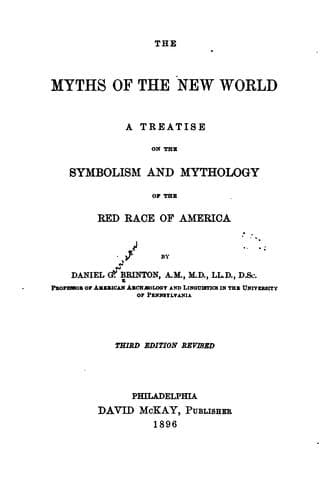
The Myths of the New World: A Treatise on the Symbolism and Mythology of the Red Race of AmericaBrinton, Daniel G. (Daniel Garrison)
Religion
The Myths of the New World: A Treatise on the Symbolism and Mythology of the Red Race of America
Brinton, Daniel G. (Daniel Garrison)
Indian mythology; Indians -- Folklore
In snake charming as a proof of proficiency in magic, and in the symbol
of the lightning, which brings both fire and water, which in its might
controls victory in war, and in its frequency, plenteous crops at home,
lies the secret of the serpent symbol. As the "war physic" among the
tribes of the United States was a fragment of a serpent, and as thus
signifying his incomparable skill in war, the Iroquois represent their
mythical king Atatarho clothed in nothing but black snakes; so that when
he wished to don a new suit he simply drove away one set and ordered
another to take their places,[118-1] so, by a precisely similar mental
process, the myth of the Nahuas assigns as a mother to their war god
Huitzilapochtli, Coatlicue, the robe of serpents; her dwelling place
Coatepec, the hill of serpents; and at her lying-in say that she brought
forth a serpent. Her son's image was surrounded by serpents, his sceptre
was in the shape of one, his great drum was of serpents' skins, and his
statue rested on four vermiform caryatides.
As the symbol of the fertilizing summer showers the lightning serpent
was the god of fruitfulness. Born in the atmospheric waters, it was an
appropriate attribute of the ruler of the winds. But we have already
seen that the winds were often spoken of as great birds. Hence the union
of these two emblems in such names as Quetzalcoatl, Gucumatz, Kukulkan,
all titles of the god of the air in the languages of Central America,
all signifying the "Bird-serpent." Here also we see the solution of that
monument which has so puzzled American antiquaries, the cross at
Palenque. It is a tablet on the wall of an altar representing a cross
surmounted by a bird and supported by the head of a serpent. The latter
is not well defined in the plate in Mr. Stephens' Travels, but is very
distinct in the photographs taken by M. Charnay, which that gentleman
was kind enough to show me. The cross I have previously shown was the
symbol of the four winds, and the bird and serpent are simply the rebus
of the air god, their ruler.[119-1] Quetzalcoatl, called also Yolcuat,
the rattlesnake, was no less intimately associated with serpents than
with birds. The entrance to his temple at Mexico represented the jaws of
one of these reptiles, and he finally disappeared in the province of
Coatzacoalco, the hiding place of the serpent, sailing towards the east
in a bark of serpents' skins. All this refers to his power over the
lightning serpent.
Public-domain text, read in full here on John Shaqi.
Reviews
Reviews
No reviews yet
Be the first to share your thoughts on this work.
Elsewhere in the archive
Join the Discussion
Join the discussion
Sign in to leave a comment or review.
Sign InorCreate an account