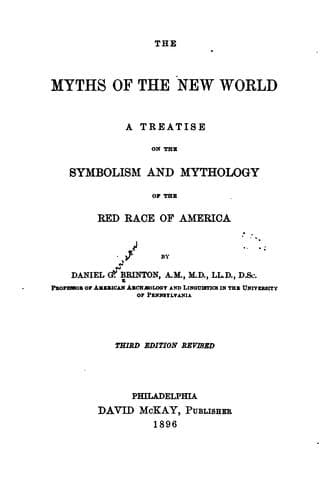
The Myths of the New World: A Treatise on the Symbolism and Mythology of the Red Race of AmericaBrinton, Daniel G. (Daniel Garrison)
Religion
The Myths of the New World: A Treatise on the Symbolism and Mythology of the Red Race of America
Brinton, Daniel G. (Daniel Garrison)
Indian mythology; Indians -- Folklore
He was also said to be the god of riches and the patron consequently of
merchants. For with the summer lightning come the harvest and the
ripening fruits, come riches and traffic. Moreover "the golden color of
the liquid fire," as Lucretius expresses it, naturally led where this
metal was known, to its being deemed the product of the lightning. Thus
originated many of those tales of a dragon who watches a treasure in the
earth, and of a serpent who is the dispenser of riches, such as were
found among the Greeks and ancient Germans.[119-2] So it was in Peru
where the god of riches was worshipped under the image of a rattlesnake
horned and hairy, with a tail of gold. It was said to have descended
from the heavens in the sight of all the people, and to have been seen
by the whole army of the Inca.[119-3] Whether it was in reference to
it, or as emblems of their prowess, that the Incas themselves chose as
their arms two serpents with their tails interlaced, is uncertain;
possibly one for each of these significations.
Because the rattlesnake, the lightning serpent, is thus connected with
the food of man, and itself seems never to die but annually to renew its
youth, the Algonkins called it "grandfather" and "king of snakes;" they
feared to injure it; they believed it could grant prosperous breezes, or
raise disastrous tempests; crowned with the lunar crescent it was the
constant symbol of life in their picture writing; and in the meda signs
the mythical grandmother of mankind _me suk kum me go kwa_ was
indifferently represented by an old woman or a serpent.[120-1] For like
reasons Cihuacoatl, the Serpent Woman, in the myths of the Nahuas was
also called Tonantzin, our mother.[120-2]
The serpent symbol in America has, however, been brought into undue
prominence. It had such an ominous significance in Christian art, and
one which chimed so well with the favorite proverb of the early
missionaries--"the gods of the heathens are devils"--that wherever they
saw a carving or picture of a serpent they at once recognized the sign
manual of the Prince of Darkness, and inscribed the fact in their
note-books as proof positive of their cherished theory. After going
over the whole ground, I am convinced that none of the tribes of the red
race attached to this symbol any ethical significance whatever, and that
as employed to express atmospheric phenomena, and the recognition of
divinity in natural occurrences, it far more frequently typified what
was favorable and agreeable than the reverse.
FOOTNOTES:
[101-1] That these were the real views entertained by the Indians in
regard to the brute creation, see Heckewelder, _Acc. of the Ind.
Nations_, p. 247; Schoolcraft, _Ind. Tribes_, iii. p. 520.
[101-2] Egede, _Nachrichten von Grönland_, p. 156.
[102-1] _Voiages aux Indes Occidentales_, pt. ii. p. 203: Amst. 1722.
[102-2] Beverly, _Hist. de la Virginie_, liv. iii. chap. viii.
[103-1] Schoolcraft, _Ind. Tribes_, v. p. 420.
Public-domain text, read in full here on John Shaqi.
Reviews
Reviews
No reviews yet
Be the first to share your thoughts on this work.
Elsewhere in the archive
Join the Discussion
Join the discussion
Sign in to leave a comment or review.
Sign InorCreate an account