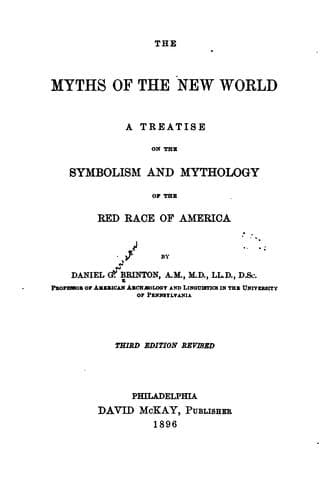
The Myths of the New World: A Treatise on the Symbolism and Mythology of the Red Race of AmericaBrinton, Daniel G. (Daniel Garrison)
Religion
The Myths of the New World: A Treatise on the Symbolism and Mythology of the Red Race of America
Brinton, Daniel G. (Daniel Garrison)
Indian mythology; Indians -- Folklore
[113-3] _Sagen der Nord-Amer. Indianer_, p. 21. This is a German
translation of part of Jones's _Legends of the N. Am. Inds._: London,
1820. Their value as mythological material is very small.
[114-1] Torquemada, _Monarquia Indiana_, lib. vi. cap. 37.
[114-2] Müller, _Amer. Urrelig._, 221, after De la Borde.
[114-3] _Le Livre Sacré des Quichés_, p. 3.
[114-4] _Rel. de la Nouv. France_, 1648, p. 75.
[115-1] _Memoirs of Lieut. Henry Timberlake_, p. 48: London, 1765. This
little book gives an account of the Cherokees at an earlier date than is
elsewhere found.
[116-1] Hawkins, _Sketch of the Creek Country_, p. 80.
[116-2] Schoolcraft, _Algic Researches_, i. p. 179 sq.; compare ii. p.
117.
[116-3] Morgan, _League of the Iroquois_, p. 159; Cusic, _Trad. Hist. of
the Six Nations_, pt. ii.
[117-1] Mrs. Eastman, _Legends of the Sioux_, pp. 161, 212. In this
explanation I depart from Prof. Schwarz, who has collected various
legends almost identical with these of the Indians (with which he was not
acquainted), and interpreted the precious crown or horn to be the summer
sun, brought forth by the early vernal lightning. _Ursprung der
Mythologie_, p. 27, note.
[118-1] Cusic, u. s., pt. ii.
[119-1] This remarkable relic has been the subject of a long and able
article in the _Revue Américaine_ (tom. ii. p. 69), by the venerable
traveller De Waldeck. Like myself--and I had not seen his opinion until
after the above was written--he explains the cruciform design as
indicating the four cardinal points, but offers the explanation merely as
a suggestion, and without referring to these symbols as they appear in so
many other connections.
[119-2] Schwarz, _Ursprung der Mythologie_, pp. 62 sqq.
[119-3] "I have examined many Indians in reference to these details,"
says the narrator, an Augustin monk writing in 1554, "and they have all
confirmed them as eye-witnesses" (_Lettre sur les Superstitions du
Pérou_, p. 106, ed. Ternaux-Compans. This document is very valuable).
[120-1] _Narrative of John Tanner_, p. 355; Henry, _Travels_, p. 176.
[120-2] Torquemada, _Monarquia Indiana_, lib. vi. cap. 31.
CHAPTER V.
THE MYTHS OF WATER, FIRE, AND THE THUNDER-STORM.
Water the oldest element.--Its use in purification.--Holy
water.--The Rite of Baptism.--The Water of Life.--Its symbols.--The
Vase.--The Moon.--The latter the goddess of love and agriculture,
but also of sickness, night, and pain.--Often represented by a
dog.--Fire worship under the form of Sun worship.--The perpetual
fire.--The new fire--Burning the dead.--A worship of the passions,
but no sexual dualism in myths, nor any phallic worship in
America.--Synthesis of the worship of Fire, Water, and the Winds in
the THUNDER-STORM, personified as Haokah, Tupa, Catequil, Contici,
Heno, Tlaloc, Mixcoatl, and other deities, many of them triune.
Public-domain text, read in full here on John Shaqi.
Reviews
Reviews
No reviews yet
Be the first to share your thoughts on this work.
Elsewhere in the archive
Join the Discussion
Join the discussion
Sign in to leave a comment or review.
Sign InorCreate an account