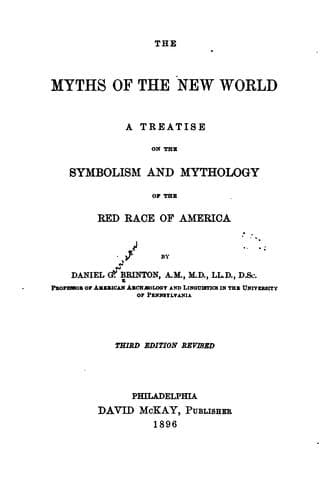
The Myths of the New World: A Treatise on the Symbolism and Mythology of the Red Race of AmericaBrinton, Daniel G. (Daniel Garrison)
Religion
The Myths of the New World: A Treatise on the Symbolism and Mythology of the Red Race of America
Brinton, Daniel G. (Daniel Garrison)
Indian mythology; Indians -- Folklore
[103-2] Mrs. Eastman, _Legends of the Sioux_, p. 191: New York, 1849.
This is a trustworthy and meritorious book, which can be said of very few
collections of Indian traditions. They were collected during a residence
of seven years in our northwestern territories, and are usually verbally
faithful to the native narrations.
[104-1] Müller, _Amer. Urreligionen_, p. 222, after De la Borde.
[105-1] _Acc. of the Inds. of California_, ch. ix. Eng. trans. by
Robinson: New York, 1847. The Acagchemem were a branch of the Netela
tribe, who dwelt near the mission San Juan Capistrano (see Buschmann,
_Spuren der Aztek. Sprache_, etc., p. 548).
[106-1] Called in the Aztec tongue _Tecolotl_, night owl; literally, the
stone scorpion. The transfer was mythological. The Christians prefixed to
this word _tlaca_, man, and thus formed a name for Satan, which Prescott
and others have translated "rational owl." No such deity existed in
ancient Anahuac (see Buschmann, _Die Voelker und Sprachen Neu Mexico's_,
p. 262).
[106-2] Schoolcraft, _Ind. Tribes_, v. p. 420.
[106-3] William Bartram, Travels, p. 504. Columbus found the natives of
the Antilles wearing tunics with figures of these birds embroidered upon
them. Prescott, _Conq. of Mexico_, i. p. 58, note.
[107-1] _Rel. de la Nouv. France_, An 1636, ch. ix. Catlin, _Letters and
notes_, Lett. 22.
[108-1] _Rel. de la Nouv. France_, An 1648, p. 75; Cusic, _Trad. Hist. of
the Six Nations_, pt. iii. The latter is the work of a native Tuscarora
chief. It is republished in Schoolcraft's Indian Tribes, but is of little
value.
[109-1] For example, in Brazil, Müller, _Amer. Urrelig._, p. 277; in
Yucatan, Cogolludo, _Hist. de Yucathan_, lib. iv. cap. 4; among the
western Algonkins, _Hennepin, Decouverte dans l'Amer. Septen_. chap. 33.
Dr. Hammond has expressed the opinion that the North American Indians
enjoy the same immunity from the virus of the rattlesnake, that certain
African tribes do from some vegetable poisons (_Hygiene_, p. 73). But his
observation must be at fault, for many travellers mention the dread these
serpents inspired, and the frequency of death from their bites, e. g.
_Rel. Nouv. France_. 1667, p. 22.
[109-2] _Narrative of the Captivity and Adventures of John Tanner_, p.
356.
[110-1] See Gallatin's vocabularies in the second volume of the _Trans.
Am. Antiq. Soc._ under the word _Snake_. In Arabic _dzann_ is serpent;
_dzanan_ a spirit, a soul, or the heart. So in Hebrew _nachas_, serpent,
has many derivatives signifying to hold intercourse with demons, to
conjure, a magician, etc. See Noldeke in the _Zeitschrift für
Voelkerpsychologie und Sprachwissenschaft_, i. p. 413.
[111-1] Alexander Henry, _Travels_, p. 117.
[111-2] _Bost. Med. and Surg. Journal_, vol. 76, p. 21.
[113-1] Schwarz, _Der Ursprung der Mythologie dargelegt an Griechischer
und Deutscher Sage_: Berlin, 1860, _passim_.
[113-2] _Rel. de la Nouv. France_: An 1637, p. 53.
Public-domain text, read in full here on John Shaqi.
Reviews
Reviews
No reviews yet
Be the first to share your thoughts on this work.
Elsewhere in the archive
Join the Discussion
Join the discussion
Sign in to leave a comment or review.
Sign InorCreate an account