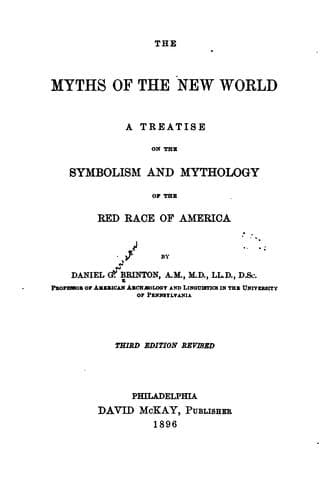
The Myths of the New World: A Treatise on the Symbolism and Mythology of the Red Race of AmericaBrinton, Daniel G. (Daniel Garrison)
Religion
The Myths of the New World: A Treatise on the Symbolism and Mythology of the Red Race of America
Brinton, Daniel G. (Daniel Garrison)
Indian mythology; Indians -- Folklore
The adoration of streams, springs, and lakes, or rather of the spirits
their rulers, prevailed everywhere; sometimes avowedly because they
provided food, as was the case with the Moxos, who called themselves
children of the lake or river on which their village was, and were
afraid to migrate lest their parent should be vexed;[124-1] sometimes
because they were the means of irrigation, as in Peru, or on more
general mythical grounds. A grove by a fountain is in all nature worship
the ready-made shrine of the sylphs who live in its limpid waves and
chatter mysteriously in its shallows. On such a spot in our Gulf States
one rarely fails to find the sacrificial mound of the ancient
inhabitants, and on such the natives of Central America were wont to
erect their altars (Ximenes). Lakes are the natural centres of
civilization. Like the lacustrine villages which the Swiss erected in
ante-historic times, like ancient Venice, the city of Mexico was first
built on piles in a lake, and for the same reason--protection from
attack. Security once obtained, growth and power followed. Thus we can
trace the earliest rays of Aztec civilization rising from lake Tezcuco,
of the Peruvian from Lake Titicaca, of the Muyscas from Lake Guatavita.
These are the centres of legendary cycles. Their waters were hallowed by
venerable reminiscences. From the depths of Titicaca rose Viracocha,
mythical civilizer of Peru. Guatavita was the bourne of many a foot-sore
pilgrim in the ancient empire of the Zac. Once a year the high priest
poured the collective offerings of the multitude into its waves, and
anointed with oils and glittering with gold dust, dived deep in its
midst, professing to hold communion with the goddess who there had her
home.[125-1]
Not only does the life of man but his well-being depends on water. As an
ablution it invigorates him bodily and mentally. No institution was in
higher honor among the North American Indians than the sweat-bath
followed by the cold douche. It was popular not only as a remedy in
every and any disease, but as a preliminary to a council or an important
transaction. Its real value in cold climates is proven by the sustained
fondness for the Russian bath in the north of Europe. The Indians,
however, with their usual superstition attributed its good effects to
some mysterious healing power in water itself. Therefore, when the
patient was not able to undergo the usual process, or when his medical
attendant was above the vulgar and routine practice of his profession,
it was administered on the infinitesimal system. The quack muttered a
formula over a gourd filled from a neighboring spring and sprinkled it
on his patient, or washed the diseased part, or sucked out the evil
spirit and blew it into a bowl of water, and then scattered the liquid
on the fire or earth.[125-2]
Public-domain text, read in full here on John Shaqi.
Reviews
Reviews
No reviews yet
Be the first to share your thoughts on this work.
Elsewhere in the archive
Join the Discussion
Join the discussion
Sign in to leave a comment or review.
Sign InorCreate an account