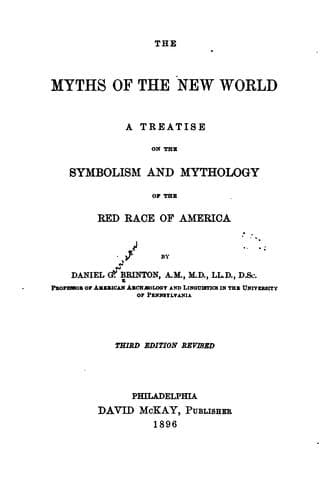
The Myths of the New World: A Treatise on the Symbolism and Mythology of the Red Race of AmericaBrinton, Daniel G. (Daniel Garrison)
Religion
The Myths of the New World: A Treatise on the Symbolism and Mythology of the Red Race of America
Brinton, Daniel G. (Daniel Garrison)
Indian mythology; Indians -- Folklore
The use of such "holy water" astonished the Romanist missionaries, and
they at once detected Satan parodying the Scriptures. But their
astonishment rose to horror when they discovered among various nations a
rite of baptism of appalling similarity to their own, connected with
the imposing of a name, done avowedly for the purpose of freeing from
inherent sin, believed to produce a regeneration of the spiritual
nature, nay, in more than one instance called by an indigenous word
signifying "to be born again."[126-1] Such a rite was of immemorial
antiquity among the Cherokees, Aztecs, Mayas, and Peruvians. Had the
missionaries remembered that it was practised in Asia with all these
meanings long before it was chosen as the sign of the new covenant, they
need have invoked neither Satan nor Saint Thomas to explain its presence
in America.
As corporeal is near akin to spiritual pollution, and cleanliness to
godliness, ablution preparatory to engaging in religious acts came early
to have an emblematic as well as a real significance. The water freed
the soul from sin as it did the skin from stain. We should come to God
with clean hands and a clean heart. As Pilate washed his hands before
the multitude to indicate that he would not accept the moral
responsibility of their acts, so from a similar motive a Natchez chief,
who had been persuaded against his sense of duty not to sacrifice
himself on the pyre of his ruler, took clean water, washed his hands,
and threw it upon live coals.[126-2] When an ancient Peruvian had laid
bare his guilt by confession, he bathed himself in a neighboring river
and repeated this formula:--
"O thou River, receive the sins I have this day confessed unto the Sun,
carry them down to the sea, and let them never more appear."[127-1]
Public-domain text, read in full here on John Shaqi.
Reviews
Reviews
No reviews yet
Be the first to share your thoughts on this work.
Elsewhere in the archive
Join the Discussion
Join the discussion
Sign in to leave a comment or review.
Sign InorCreate an account