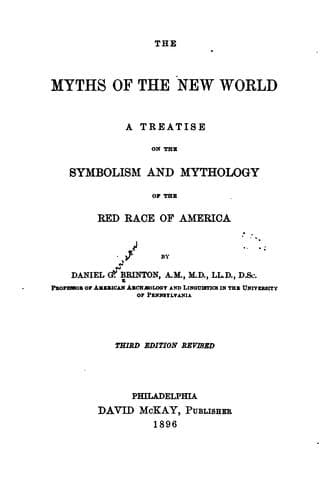
The Myths of the New World: A Treatise on the Symbolism and Mythology of the Red Race of AmericaBrinton, Daniel G. (Daniel Garrison)
Religion
The Myths of the New World: A Treatise on the Symbolism and Mythology of the Red Race of America
Brinton, Daniel G. (Daniel Garrison)
Indian mythology; Indians -- Folklore
Another reaction in the mythological laboratory is here disclosed. As
the good qualities of water were attributed to the goddess of night,
sleep, and death, so her malevolent traits were in turn reflected back
on this element. Other thoughts aided the transfer. In primitive
geography the Ocean Stream coils its infinite folds around the speck of
land we inhabit, biding its time to swallow it wholly. Unwillingly did
it yield the earth from its bosom, daily does it steal it away piece by
piece. Every evening it hides the light in its depths, and Night and the
Waters resume their ancient sway. The word for ocean (_mare_) in the
Latin tongue means by derivation a desert, and the Greeks spoke of it as
"the barren brine." Water is a treacherous element. Man treads boldly on
the solid earth, but the rivers and lakes constantly strive to swallow
those who venture within their reach. As streams run in tortuous
channels, and as rains accompany the lightning serpent, this animal was
occasionally the symbol of the waters in their dangerous manifestations.
The Huron magicians fabled that in the lakes and rivers dwelt one of
vast size called _Angont_, who sent sickness, death, and other mishaps,
and the least mite of whose flesh was a deadly poison. They added--and
this was the point of the tale--that they always kept on hand portions
of the monster for the benefit of any who opposed their designs.[136-1]
The legends of the Algonkins mention a rivalry between Michabo, creator
of the earth, and the Spirit of the Waters, who was unfriendly to the
project.[136-2] In later tales this antagonism becomes more and more
pronounced, and borrows an ethical significance which it did not have at
first. Taking, however, American religions as a whole, water is far more
frequently represented as producing beneficent effects than the reverse.
Public-domain text, read in full here on John Shaqi.
Reviews
Reviews
No reviews yet
Be the first to share your thoughts on this work.
Elsewhere in the archive
Join the Discussion
Join the discussion
Sign in to leave a comment or review.
Sign InorCreate an account