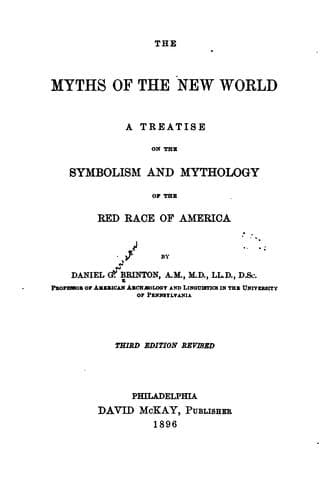
The Myths of the New World: A Treatise on the Symbolism and Mythology of the Red Race of AmericaBrinton, Daniel G. (Daniel Garrison)
Religion
The Myths of the New World: A Treatise on the Symbolism and Mythology of the Red Race of America
Brinton, Daniel G. (Daniel Garrison)
Indian mythology; Indians -- Folklore
Dogs were supposed to stand in some peculiar relation to the moon,
probably because they howl at it and run at night, uncanny practices
which have cost them dear in reputation. The custom prevailed among
tribes so widely asunder as Peruvians, Tupis, Creeks, Iroquois,
Algonkins, and Greenland Eskimos to thrash the curs most soundly during
an eclipse.[137-1] The Creeks explained this by saying that the big dog
was swallowing the sun, and that by whipping the little ones they could
make him desist. What the big dog was they were not prepared to say. We
know. It was the night goddess, represented by the dog, who was thus
shrouding the world at midday. The ancient Romans sacrificed dogs to
Hecate and Diana, in Egypt they were sacred to Isis, and thus as
traditionally connected with night and its terrors, the Prince of
Darkness, in the superstition of the middle ages, preferably appeared
under the form of a cur, as that famous poodle which accompanied
Cornelius Agrippa, or that which grew to such enormous size behind the
stove of Dr. Faustus. In a better sense, they represented the more
agreeable characteristics of the lunar goddess. Xochiquetzal, most
fecund of Aztec divinities, patroness of love, of sexual pleasure, and
of childbirth, was likewise called _Itzcuinan_, which, literally
translated, is _bitch-mother_. This strange and to us so repugnant title
for a goddess was not without parallel elsewhere. When in his wars the
Inca Pachacutec carried his arms into the province of Huanca, he found
its inhabitants had installed in their temples the figure of a dog as
their highest deity. They were accustomed also to select one as his
living representative, to pray to it and offer it sacrifice, and when
well fattened, to serve it up with solemn ceremonies at a great feast,
eating their god _substantialiter_. The priests in this province
summoned their attendants to the temples by blowing through an
instrument fashioned from a dog's skull.[138-1] This canine canonization
explains why in some parts of Peru a priest was called by way of honor
_allco_, dog![138-2] And why in many tombs both there and in Mexico
their skeletons are found carefully interred with the human remains.
Wherever the Aztec race extended they seem to have carried the adoration
of a wild species, the coyote, the _canis latrans_ of naturalists. The
Shoshonees of New Mexico call it their progenitor,[138-3] and with the
Nahuas it was in such high honor that it had a temple of its own, a
congregation of priests devoted to its service, statues carved in stone,
an elaborate tomb at death, and is said to be meant by the god Chantico,
whose audacity caused the destruction of the world. The story was that
he made a sacrifice to the gods without observing a preparatory fast,
for which he was punished by being changed into a dog. He then invoked
the god of death to deliver him, which attempt to evade a just
punishment so enraged the divinities that they immersed the world in
water.[139-1]
Public-domain text, read in full here on John Shaqi.
Reviews
Reviews
No reviews yet
Be the first to share your thoughts on this work.
Elsewhere in the archive
Join the Discussion
Join the discussion
Sign in to leave a comment or review.
Sign InorCreate an account