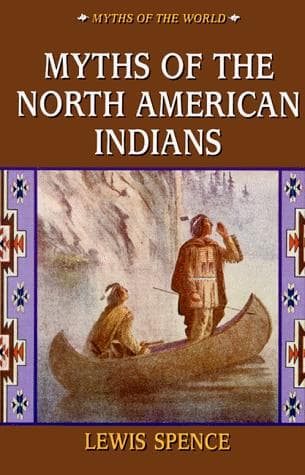
The Myths of the North American IndiansSpence, Lewis
History
The Myths of the North American Indians
Spence, Lewis
Indian mythology -- North America; Indians of North America -- Folklore
Even to-day many Iroquois allude
to Hi'nun as their grandfather, and evince extraordinary
veneration at the mention of his name.
{223}
Hiawatha
Much confusion exists with regard to the true status
of the reputed Iroquois hero Hiawatha. We find him
variously represented as a historical personage and a
mythical demi-god, and as belonging to both the
Iroquois and the Algonquins. In solid history and in
the wildest myth he is a figure of equal importance.
This confusion is largely due to the popularity of
Longfellow's poem _Hiawatha_, which by its very excellence
has given the greater prominence to the fallacies
it contains. The fact is that Longfellow, following
in the path of Schoolcraft, has really confused two
personages in the character of Hiawatha, one the
entirely mythical Manabozho, or Michabo--which
name he at first intended to bestow on his poem--and
the other the almost wholly historical Hiawatha.
Manabozho, according to tradition, was a demi-god
of the Ojibways, and to him, and not to Hiawatha,
must be credited the exploits described in the poem.
There is no doubt that myths have grown up round
the name of the Iroquois hero, for myth is the ivy that
binds all historical ruins and makes them picturesque
to the eye; but it has been proved that there is a
solid structure of fact behind the legendary stories of
Hiawatha, and even the period of his activity has been
fixed with tolerable accuracy by modern American
historians.
Hiawatha, or Hai-en-Wat-ha, was a chief of Iroquois
stock, belonging either to the Onondaga or the
Mohawk tribe. His most important feat was the
union of the Five Nations of the Iroquois into a Grand
League, an event which was of more than national
significance, since it so largely affected the fortunes of
European peoples when they afterward fought for
American supremacy. As the Five Nations are known
{224}
to have come together in the sixteenth century, it
follows that Hiawatha must have lived and worked
about that time. In later days the League was called
the Six Nations, and still more recently the Seven
Nations.
When the Iroquois, or 'Long House People,' were
found by the French and Dutch they occupied the
western part of what is now New York State, and were
at a much more advanced stage of culture than most of
the Indian tribes. They tilled the ground, cultivating
maize and tobacco, and were skilled in the arts of war
and diplomacy. They were greatly strengthened by
the Grand League, or 'Kayanerenh Kowa,' which, as
has been said, was founded by the chief Hiawatha, and
were much the most important of the North American
tribes.
Public-domain text, read in full here on John Shaqi.
Reviews
Reviews
No reviews yet
Be the first to share your thoughts on this work.
Elsewhere in the archive
Join the Discussion
Join the discussion
Sign in to leave a comment or review.
Sign InorCreate an account