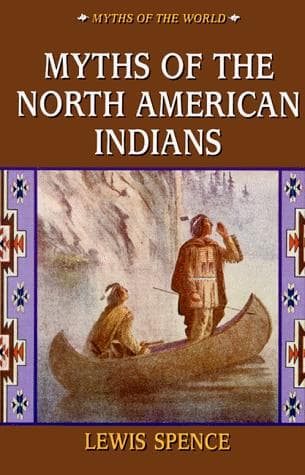
The Myths of the North American IndiansSpence, Lewis
History
The Myths of the North American Indians
Spence, Lewis
Indian mythology -- North America; Indians of North America -- Folklore
If we look to tradition for an account of the origin
of the Grand League, we learn that the union was
effected by Hiawatha in the fourteenth century. The
Hurons and Iroquois, we are told, were at one time one
people, but later they separated, the Hurons going to
the lake which is named after them, and the Iroquois
to New York, where their five tribes were united under
a General Council. But tradition is quite evidently
wrong in assigning so early a date to this important
event, for one of the two branches of the Iroquois
family (that which comprises the Mohawks and the
Oneidas) has left but few traces of an early occupation,
and these, in the shape of some old town-sites, are
judged to belong to the latter part of the sixteenth
century.
The early connexion between the Iroquois and the
Hurons, and their subsequent separation, remains
undisputed. The Iroquois family was divided into
two branches, the Sinnekes (Onondagas, Cayugas, and
{225}
Senecas) and the Caniengas (Mohawks and Oneidas),
of which the subdivisions composed the Five Nations.
The Sinnekes had established themselves in the western
portion of New York, and the Caniengas at Hochelaga
(Montreal) and elsewhere on the St. Lawrence, where
they lived amicably enough with their Algonquin
neighbours. But in 1560 a quarrel arose between the
Caniengas and the Algonquins, in which the latter
called in the aid of the Hurons. This was the
beginning of a long war, in which the Caniengas had the
worst of it. Gradually the Caniengas were driven
along the shores of Lake Champlain and Lake George
till they reached the valley of the Mohawk River, where
they established themselves in a country bordering on
that of the Onondagas.
Public-domain text, read in full here on John Shaqi.
Reviews
Reviews
No reviews yet
Be the first to share your thoughts on this work.
Elsewhere in the archive
Join the Discussion
Join the discussion
Sign in to leave a comment or review.
Sign InorCreate an account