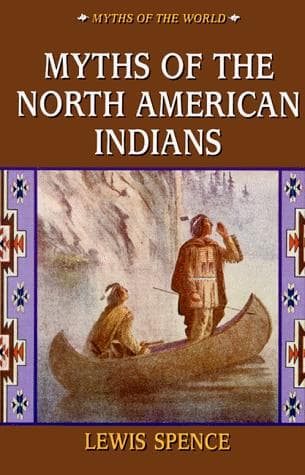
The Myths of the North American IndiansSpence, Lewis
History
The Myths of the North American Indians
Spence, Lewis
Indian mythology -- North America; Indians of North America -- Folklore
through, and fat only in summer; as has since been the case.
"According to Hearne, the Tinneh believe in a kind of spirits, or
fairies, called _nantena_, which people the earth, the sea, and the
air, and are instrumental for both good and evil. Some of them believe
in a good spirit called Tihugun, 'my old friend,' supposed to reside in
the sun and in the moon; they have also a bad spirit, Chutsain,
apparently only a personification of death, and for this reason called
bad.
"They have no regular order of _shamans_; any one when the spirit moves
him may take upon himself their duties and pretensions, though some by
happy chances, or peculiar cunning, are much more highly esteemed in
this regard than others, and are supported by voluntary contributions.
The conjurer often shuts himself in his tent and abstains from food for
days till his earthly grossness thins away, and the spirits and things
unseen are constrained to appear at his behest. The young Tinneh care
for none of these things; the strong limb and the keen eye, holding
their own well in the jostle of life, mock at the terrors of the
invisible; but as the pulses dwindle with disease or age, and the knees
strike together in the shadow of impending death, the _shaman_ is hired
to expel the evil things of which a patient is possessed. Among the
Tacullies a confession is often resorted to at this stage, on the truth
and accuracy of which depend the chances of a recovery."
Conclusion
In concluding this survey of representative myths of the Red Race of
North America, the reader will probably be chiefly impressed with the
circumstance that although many of these tales exhibit a striking {359}
resemblance to the myths of European and Asiatic peoples they have yet
an atmosphere of their own which strongly differentiates them from the
folk-tales of all other races. It is a truism in mythology that
although the tales and mythological systems of peoples dwelling widely
apart may show much likeness to one another, such a resemblance cannot
be advanced as a proof that the divergent races at some distant period
possessed a common mythology. Certain tribes in Borneo live in huts
built on piles driven into lake-beds and use blow-pipes; so do some
Indians of Guiana and contiguous countries; yet no scientist of
experience would be so rash as to advance the theory that these races
possessed a common origin. It is the same with mythological processes,
which may have been evolved separately at great distances, but yet
exhibit a marked likeness. These resemblances arise from the
circumstance that the mind of man, whether he be situated in China or
Peru, works on surprisingly similar lines. But, as has been indicated,
the best proof that the myths of North America have not been
sophisticated by those of Europe and Asia is the circumstance that the
aboriginal atmosphere they contain is so marked that even the most
superficial observer could not fail to observe its presence. In the
Public-domain text, read in full here on John Shaqi.
Reviews
Reviews
No reviews yet
Be the first to share your thoughts on this work.
Elsewhere in the archive
Join the Discussion
Join the discussion
Sign in to leave a comment or review.
Sign InorCreate an account