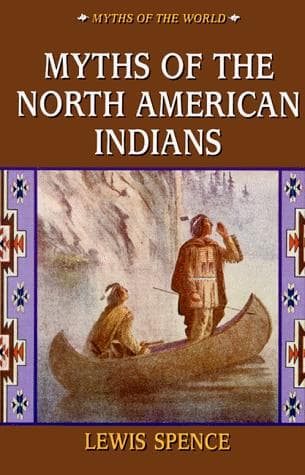
The Myths of the North American IndiansSpence, Lewis
History
The Myths of the North American Indians
Spence, Lewis
Indian mythology -- North America; Indians of North America -- Folklore
The other god was called Wac, or Tuparan. According to the Niparaya
sect, this Wac had made war on their favourite god, and had been by him
defeated and cast forth from heaven into a cave under the earth, of
which cave the whales of the sea were the guardians. With a perverse,
though not unnatural, obstinacy, the sect that took Wac or Tuparan for
their great god persisted in holding ideas peculiar to themselves with
regard to the truth of the foregoing story, and their account of the
great war in heaven and its results differed from the other as differ
the creeds of heterodox and orthodox everywhere; they ascribe, for
example, part of the creation to other gods besides Niparaya.
Myths of the Athapascans
The great Athapascan family, who inhabit a vast extent of territory
stretching north from the fifty-fifth parallel nearly to the Arctic
Ocean, and westward to the Pacific, with cognate ramifications to the
far south, are weak in mythological conceptions. Regarding them
Bancroft says:[4]
[4] _The Native Races of the Pacific States_, vol. iii.
{357}
"They do not seem in any of their various tribes to have a single
expressed idea with regard to a supreme power. The Loucheux branch
recognize a certain personage, resident in the moon, whom they
supplicate for success in starting on a hunting expedition. This being
once lived among them as a poor ragged boy that an old woman had found
and was bringing up; and who made himself ridiculous to his fellows by
making a pair of very large snow-shoes; for the people could not see
what a starveling like him should want with shoes of such unusual size.
Times of great scarcity troubled the hunters, and they would often have
fared badly had they not invariably on such occasions come across a new
broad trail that led to a head or two of freshly killed game. They
were glad enough to get the game and without scruples as to its
appropriation; still they felt curious as to whence it came and how.
Suspicion at last pointing to the boy and his great shoes as being in
some way implicated in the affair, he was watched. It soon became
evident that he was indeed the benefactor of the Loucheux, and the
secret hunter whose quarry had so often replenished their empty pots;
yet the people were far from being adequately grateful, and continued
to treat him with little kindness or respect. On one occasion they
refused him a certain piece of fat--him who had so often saved their
lives by his timely bounty! That night the lad disappeared, leaving
only his clothes behind, hanging on a tree. He returned to them in a
month, however, appearing as a man, and dressed as a man. He told them
that he had taken up his home in the moon; that he would always look
down with a kindly eye to their success in hunting; but he added that
as a punishment for their shameless greed and ingratitude in refusing
him the piece of fat, all animals {358} should be lean the long winter
Public-domain text, read in full here on John Shaqi.
Reviews
Reviews
No reviews yet
Be the first to share your thoughts on this work.
Elsewhere in the archive
Join the Discussion
Join the discussion
Sign in to leave a comment or review.
Sign InorCreate an account