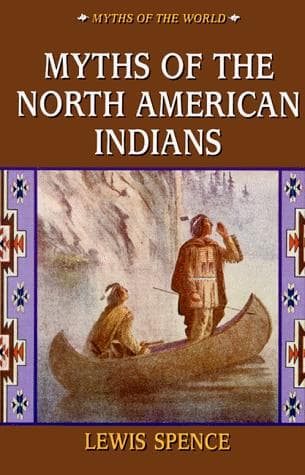
The Myths of the North American IndiansSpence, Lewis
History
The Myths of the North American Indians
Spence, Lewis
Indian mythology -- North America; Indians of North America -- Folklore
But Malsum resolved to learn his brother's secret and to destroy him at
the first opportunity. Glooskap had told him subsequently to his first
attempt that only a pine-root could kill him, and with this Malsum
struck him while he slept as before, but Glooskap, rising up and
laughing, drove Malsum into the forest, and seated himself by a stream,
where he murmured, as if musing to himself: "Only a flowering rush can
kill me." Now he said this because he knew that Quah-beet, the Great
Beaver, was hidden among the rushes on the bank of the stream and would
hear every word he uttered. The Beaver went at once to Malsum and told
him what he regarded as his brother's vital secret. The wicked Malsum
was so glad that he promised to give the Beaver whatever he might ask
for. But when the beast asked for wings like a pigeon Malsum burst
into mocking laughter and cried: "Ho, you with the tail like a file,
what need have you of wings?" At this the Beaver was wroth, and, going
to Glooskap, made a clean breast of what he had done. Glooskap, now
thoroughly infuriated, dug up a fern-root, and, rushing into the
recesses of the forest, sought out his treacherous brother and with a
blow of the fatal plant struck him dead.
{143}
Scandinavian Analogies
But although Malsum was slain he subsequently appears in Algonquian
myth as Lox, or Loki, the chief of the wolves, a mischievous and
restless spirit. In his account of the Algonquian mythology Charles
Godfrey Leland appears to think that the entire system has been
sophisticated by Norse mythology filtering through the Eskimo.
Although the probabilities are against such a theory, there are many
points in common between the two systems, as we shall see later, and
among them few are more striking than the fact that the Scandinavian
and Algonquian evil influences possess one and the same name.
When Glooskap had completed the world he made man and the smaller
supernatural beings, such as fairies and dwarfs. He formed man from
the trunk of an ash-tree, and the elves from its bark. Like Odin, he
trained two birds to bring him the news of the world, but their
absences were so prolonged that he selected a black and a white wolf as
his attendants. He waged a strenuous and exterminating warfare on the
evil monsters which then infested the world, and on the sorcerers and
witches who were harmful to man. He levelled the hills and restrained
the forces of nature in his mighty struggles, in which he towered to
giant stature, his head and shoulders rising high above the clouds.
Yet in his dealings with men he was gentle and quietly humorous, not to
say ingenuous.
Public-domain text, read in full here on John Shaqi.
Reviews
Reviews
No reviews yet
Be the first to share your thoughts on this work.
Elsewhere in the archive
Join the Discussion
Join the discussion
Sign in to leave a comment or review.
Sign InorCreate an account