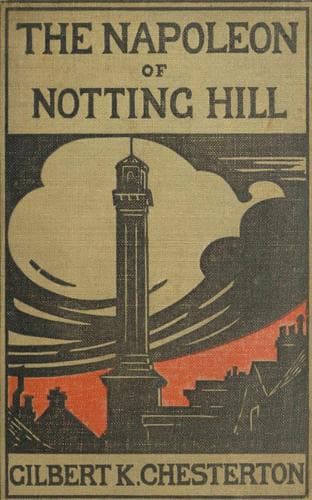
The Napoleon of Notting HillChesterton, G. K. (Gilbert Keith)
Science
The Napoleon of Notting Hill
Chesterton, G. K. (Gilbert Keith)
Fantasy fiction; Notting Hill (London, England) -- Fiction; Political fiction
As they passed up the long streets towards their restaurant the copper
twilight cleared slowly to a pale yellow, and by the time they reached
it they stood discernible in a tolerable winter daylight. The
Honourable James Barker, one of the most powerful officials in the
English Government (by this time a rigidly official one), was a lean
and elegant young man, with a blank handsome face and bleak blue eyes.
He had a great amount of intellectual capacity, of that peculiar kind
which raises a man from throne to throne and lets him die loaded with
honours without having either amused or enlightened the mind of a
single man. Wilfrid Lambert, the youth with the nose which appeared to
impoverish the rest of his face, had also contributed little to the
enlargement of the human spirit, but he had the honourable excuse of
being a fool.
Lambert would have been called a silly man; Barker, with all his
cleverness, might have been called a stupid man. But mere silliness
and stupidity sank into insignificance in the presence of the awful
and mysterious treasures of foolishness apparently stored up in the
small figure that stood waiting for them outside Cicconani's. The
little man, whose name was Auberon Quin, had an appearance compounded
of a baby and an owl. His round head, round eyes, seemed to have been
designed by nature playfully with a pair of compasses. His flat dark
hair and preposterously long frock-coat gave him something of the look
of a child's "Noah." When he entered a room of strangers, they mistook
him for a small boy, and wanted to take him on their knees, until he
spoke, when they perceived that a boy would have been more
intelligent.
"I have been waiting quite a long time," said Quin, mildly. "It's
awfully funny I should see you coming up the street at last."
"Why?" asked Lambert, staring. "You told us to come here yourself."
"My mother used to tell people to come to places," said the sage.
They were about to turn into the restaurant with a resigned air, when
their eyes were caught by something in the street. The weather, though
cold and blank, was now quite clear, and across the dull brown of the
wood pavement and between the dull grey terraces was moving something
not to be seen for miles round--not to be seen perhaps at that time in
England--a man dressed in bright colours. A small crowd hung on the
man's heels.
Public-domain text, read in full here on John Shaqi.
Reviews
Reviews
No reviews yet
Be the first to share your thoughts on this work.
Join the Discussion
Join the discussion
Sign in to leave a comment or review.
Sign InorCreate an account