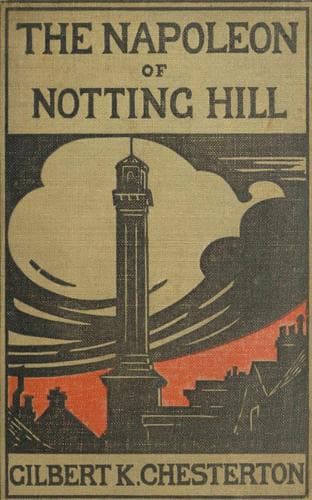
The Napoleon of Notting HillChesterton, G. K. (Gilbert Keith)
Science
The Napoleon of Notting Hill
Chesterton, G. K. (Gilbert Keith)
Fantasy fiction; Notting Hill (London, England) -- Fiction; Political fiction
"Here is another," continued the insatiable Quin. "In a hollow of the
grey-green hills of rainy Ireland, lived an old, old woman, whose
uncle was always Cambridge at the Boat Race. But in her grey-green
hollows, she knew nothing of this: she didn't know that there was a
Boat Race. Also she did not know that she had an uncle. She had heard
of nobody at all, except of George the First, of whom she had heard (I
know not why), and in whose historical memory she put her simple
trust. And by and by in God's good time, it was discovered that this
uncle of hers was not really her uncle, and they came and told her so.
She smiled through her tears, and said only, 'Virtue is its own
reward.'"
Again there was a silence, and then Lambert said--
"It seems a bit mysterious."
"Mysterious!" cried the other. "The true humour is mysterious. Do you
not realise the chief incident of the nineteenth and twentieth
centuries?"
"And what's that?" asked Lambert, shortly.
"It is very simple," replied the other. "Hitherto it was the ruin of a
joke that people did not see it. Now it is the sublime victory of a
joke that people do not see it. Humour, my friends, is the one
sanctity remaining to mankind. It is the one thing you are thoroughly
afraid of. Look at that tree."
His interlocutors looked vaguely towards a beech that leant out
towards them from the ridge of the hill.
"If," said Mr. Quin, "I were to say that you did not see the great
truths of science exhibited by that tree, though they stared any man
of intellect in the face, what would you think or say? You would
merely regard me as a pedant with some unimportant theory about
vegetable cells. If I were to say that you did not see in that tree
the vile mismanagement of local politics, you would dismiss me as a
Socialist crank with some particular fad about public parks. If I were
to say that you were guilty of the supreme blasphemy of looking at
that tree and not seeing in it a new religion, a special revelation of
God, you would simply say I was a mystic, and think no more about me.
But if"--and he lifted a pontifical hand--"if I say that you cannot
see the humour of that tree, and that I see the humour of it--my God!
you will roll about at my feet."
He paused a moment, and then resumed.
"Yes; a sense of humour, a weird and delicate sense of humour, is the
new religion of mankind! It is towards that men will strain themselves
with the asceticism of saints. Exercises, spiritual exercises, will be
set in it. It will be asked, 'Can you see the humour of this iron
railing?' or 'Can you see the humour of this field of corn? Can you
see the humour of the stars? Can you see the humour of the sunsets?'
How often I have laughed myself to sleep over a violet sunset."
"Quite so," said Mr. Barker, with an intelligent embarrassment.
Public-domain text, read in full here on John Shaqi.
Reviews
Reviews
No reviews yet
Be the first to share your thoughts on this work.
Join the Discussion
Join the discussion
Sign in to leave a comment or review.
Sign InorCreate an account