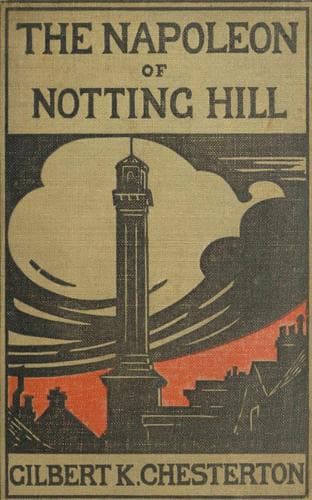
The Napoleon of Notting HillChesterton, G. K. (Gilbert Keith)
Science
The Napoleon of Notting Hill
Chesterton, G. K. (Gilbert Keith)
Fantasy fiction; Notting Hill (London, England) -- Fiction; Political fiction
"It was your Majesty who first stirred my dim patriotism into flame.
Ten years ago, when I was a boy (I am only nineteen), I was playing on
the slope of Pump Street, with a wooden sword and a paper helmet,
dreaming of great wars. In an angry trance I struck out with my sword,
and stood petrified, for I saw that I had struck you, Sire, my King,
as you wandered in a noble secrecy, watching over your people's
welfare. But I need have had no fear. Then was I taught to understand
Kingliness. You neither shrank nor frowned. You summoned no guards.
You invoked no punishments. But in august and burning words, which are
written in my soul, never to be erased, you told me ever to turn my
sword against the enemies of my inviolate city. Like a priest pointing
to the altar, you pointed to the hill of Notting. 'So long,' you said,
'as you are ready to die for the sacred mountain, even if it were
ringed with all the armies of Bayswater.' I have not forgotten the
words, and I have reason now to remember them, for the hour is come
and the crown of your prophecy. The sacred hill is ringed with the
armies of Bayswater, and I am ready to die."
The King was lying back in his chair, a kind of wreck.
"Oh, Lord, Lord, Lord," he murmured, "what a life! what a life! All my
work! I seem to have done it all. So you're the red-haired boy that
hit me in the waistcoat. What have I done? God, what have I done? I
thought I would have a joke, and I have created a passion. I tried to
compose a burlesque, and it seems to be turning halfway through into
an epic. What is to be done with such a world? In the Lord's name,
wasn't the joke broad and bold enough? I abandoned my subtle humour to
amuse you, and I seem to have brought tears to your eyes. What's to be
done with people when you write a pantomime for them--call the
sausages classic festoons, and the policeman cut in two a tragedy of
public duty? But why am I talking? Why am I asking questions of a nice
young gentleman who is totally mad? What is the good of it? What is
the good of anything? Oh, Lord! Oh, Lord!"
Suddenly he pulled himself upright.
"Don't you really think the sacred Notting Hill at all absurd?"
"Absurd?" asked Wayne, blankly. "Why should I?"
The King stared back equally blankly.
"I beg your pardon," he said.
"Notting Hill," said the Provost, simply, "is a rise or high ground of
the common earth, on which men have built houses to live, in which
they are born, fall in love, pray, marry, and die. Why should I think
it absurd?"
The King smiled.
"Because, my Leonidas--" he began, then suddenly, he knew not how,
found his mind was a total blank. After all, why was it absurd? Why
was it absurd? He felt as if the floor of his mind had given way. He
felt as all men feel when their first principles are hit hard with a
question. Barker always felt so when the King said, "Why trouble about
politics?"
The King's thoughts were in a kind of rout; he could not collect them.
Public-domain text, read in full here on John Shaqi.
Reviews
Reviews
No reviews yet
Be the first to share your thoughts on this work.
Join the Discussion
Join the discussion
Sign in to leave a comment or review.
Sign InorCreate an account