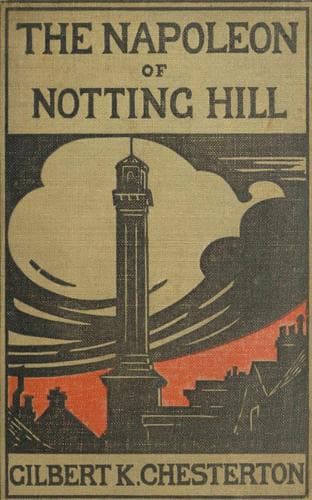
The Napoleon of Notting HillChesterton, G. K. (Gilbert Keith)
Science
The Napoleon of Notting Hill
Chesterton, G. K. (Gilbert Keith)
Fantasy fiction; Notting Hill (London, England) -- Fiction; Political fiction
"The peculiarity of these fine though feminine lines," continued
"Thunderbolt," "is, as we have said, that they praise the hansom cab
by comparing it to the shell, to a natural thing. Now, hear the author
of 'Hymns on the Hill,' and how he deals with the same subject. In his
fine nocturne, entitled 'The Last Omnibus' he relieves the rich and
poignant melancholy of the theme by a sudden sense of rushing at the
end--
'The wind round the old street corner
Swung sudden and quick as a cab.'
"Here the distinction is obvious. 'Daisy Daydream' thinks it a great
compliment to a hansom cab to be compared to one of the spiral
chambers of the sea. And the author of 'Hymns on the Hill' thinks it a
great compliment to the immortal whirlwind to be compared to a hackney
coach. He surely is the real admirer of London. We have no space to
speak of all his perfect applications of the idea; of the poem in
which, for instance, a lady's eyes are compared, not to stars, but to
two perfect street-lamps guiding the wanderer. We have no space to
speak of the fine lyric, recalling the Elizabethan spirit, in which
the poet, instead of saying that the rose and the lily contend in her
complexion, says, with a purer modernism, that the red omnibus of
Hammersmith and the white omnibus of Fulham fight there for the
mastery. How perfect the image of two contending omnibuses!"
Here, somewhat abruptly, the review concluded, probably because the
King had to send off his copy at that moment, as he was in some want
of money. But the King was a very good critic, whatever he may have
been as King, and he had, to a considerable extent, hit the right nail
on the head. "Hymns on the Hill" was not at all like the poems
originally published in praise of the poetry of London. And the
reason was that it was really written by a man who had seen nothing
else but London, and who regarded it, therefore, as the universe. It
was written by a raw, red-headed lad of seventeen, named Adam Wayne,
who had been born in Notting Hill. An accident in his seventh year
prevented his being taken away to the seaside, and thus his whole life
had been passed in his own Pump Street, and in its neighbourhood. And
the consequence was, that he saw the street-lamps as things quite as
eternal as the stars; the two fires were mingled. He saw the houses as
things enduring, like the mountains, and so he wrote about them as one
would write about mountains. Nature puts on a disguise when she speaks
to every man; to this man she put on the disguise of Notting Hill.
Nature would mean to a poet born in the Cumberland hills, a stormy
sky-line and sudden rocks. Nature would mean to a poet born in the
Essex flats, a waste of splendid waters and splendid sunsets. So
nature meant to this man Wayne a line of violet roofs and lemon lamps,
the chiaroscuro of the town. He did not think it clever or funny to
praise the shadows and colours of the town; he had seen no other
Public-domain text, read in full here on John Shaqi.
Reviews
Reviews
No reviews yet
Be the first to share your thoughts on this work.
Join the Discussion
Join the discussion
Sign in to leave a comment or review.
Sign InorCreate an account