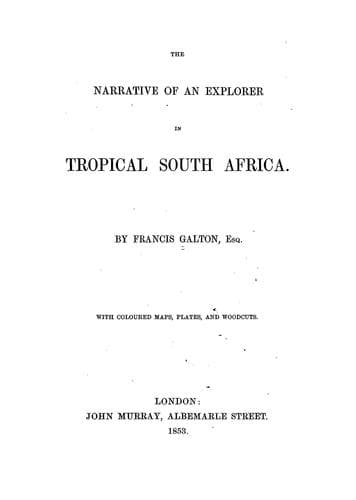
The narrative of an explorer in tropical South AfricaGalton, Francis
History
The narrative of an explorer in tropical South Africa
Galton, Francis
South Africa -- Description and travel
_March 31st._—We picked up the gemsboks by the way, and passed a large
and deep vley, in which there were some red and white geese. There are
geese and ducks on every large pool of rain-water. They must be taking
advantage of the rainy season, and travelling hither in search of food.
We saw a very large heron, or crane, an immense creature, and Andersson
shot him. The guides sauntered about two miles behind the waggons, and
the Damaras were become very slack and careless: one of them, Kahoni,
was impertinent, and refused to answer me, or to do what he was told, so
I had him down on the ground very quickly; but this time I did not whip
him, because he became penitent and communicative.
We came to a halt at a vley, where the water-course led northerly, and
the thickest of thorn-bushes penned us in elsewhere. The guides wanted us
to go due south, and strike upon the Omaramba river-bed. It was on the
upper part of this river-bed that Omagundè’s son lay; but the point where
we now should strike it would be far out of his reach. This Omoramba ran
into or out of Omanbondè,—I had never been able to make out which—and
there never was a want of well-water along it. We held a council on our
plans; but the thorns were so thick to the southward, and the distance
we had to go so uncertain,—it might be one day, it might be five,—that
I abandoned the idea of attempting it. I thought the water-course we
were on must be a tributary of the Omoramba, and determined to follow
it, especially as its direction was straight towards our point. We
were losing sight of all landmarks; nothing was to be seen but a wide
undulating plain, black with dense thorn-bushes; to the west was Ja
Kabaca, and by its side commenced the long range of Omuvereoom, high and
escarped at first, but fining down by slow degrees towards the level
of the plain. As we continued _en route_ next day, the water-course
still befriended us: its bed was never sand, but hard ground, covered
with sward, and here and there holding a pool of rain-water; and the
thick bushes were crowded on either side. It seemed as though we were
travelling along “a ride,” cut through a thick cover. We now, for the
first time, came upon elephant spoors,—huge things, indeed. There were
about twenty tracks made where the ground was soft; but it now was
hardened, and the waggon jolted heavily over them.
_April 2nd._—We came upon ox-tracks, and other indications of a Damara
werft, and following a path, came upon it. The men dispersed in great
consternation, but we caught some women, who were too heavily laden
with anklets to run fast, and pacified them with tobacco. In a short
time the men came back, and we were soon excellent friends. A fine tall
Damara, about six feet seven inches in height, offered, in the course of
conversation, to guide us to Omanbondè. He said that we should arrive
there in three days. We still were perfectly unable to understand how
large the water was, as no two people said the same thing.
Public-domain text, read in full here on John Shaqi.
Reviews
Reviews
No reviews yet
Be the first to share your thoughts on this work.
Elsewhere in the archive
Join the Discussion
Join the discussion
Sign in to leave a comment or review.
Sign InorCreate an account