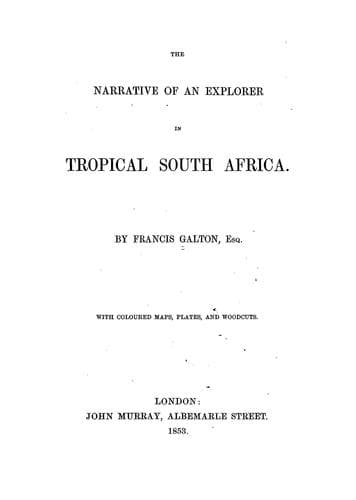
The narrative of an explorer in tropical South AfricaGalton, Francis
History
The narrative of an explorer in tropical South Africa
Galton, Francis
South Africa -- Description and travel
Our new friend became uneasy at night-fall when his companions had left
him alone, so we watched him alternately throughout the night to see
that he did not run away. I do not think the poor fellow slept a wink.
I am sure he did not in my watch, for I constantly caught his bright
eye gleaming distrustfully round, whilst he pretended to be asleep. In
the morning we went on with him, and stopped at a place which was full
of grass, about an hour off, till his companions should come to us by
a short cut over the hills. After a little time three Blacks were seen
running from the direction of Otjikongo. As soon as we could make them
out clearer, the Bushmen and Damaras all called out “Ovampo,” and so it
was.
They were part of the long-expected caravan which had arrived immediately
after we had started, and as our spoors and way of camping of course
excited the greatest curiosity among them, three men were despatched
to bring us back. They were ugly fellows, immensely muscular, and most
determined looking; they insisted that we should go back; we laughed at
them; they took our Bushman aside, and used all kinds of threats to him,
till he hardly dared proceed. In the mean time I was much struck by the
cool fearless bearing of the men and their peremptory, yet not uncivil
manner; and seeing at once that I had quite a different style of men to
deal with from either Bushmen or Damaras, I acknowledged that it was but
reasonable that they should desire to know something of a stranger before
they could allow him to pass into their country, and I returned with them
to the encampment we had that morning left.
My new acquaintances were entirely a different looking race from the
Damaras, but very like the Ghou Damup. They were ugly, bony men, with
strongly marked features, and dressed with a very funny scantiness of
attire. Their heads were shaved, and one front tooth was chipped out.
They carried little light bows three and a half feet long, and a small
and well-made assegai in one hand. On their backs were quivers, each
holding from ten to twenty well-barbed and poisoned arrows, and they
carried a dagger-knife in a neat sheath, which was either fixed to a
girdle round the waist, or else to a band that encircled the left arm
above the elbow. Their necks were laden with necklaces for sale, and
every man carried a long narrow smoothed pole over his shoulder, from
either end of which hung a quantity of packages. These were chiefly
little baskets holding iron articles of exchange, packets of corn for
their own eating, and water bags.
Public-domain text, read in full here on John Shaqi.
Reviews
Reviews
No reviews yet
Be the first to share your thoughts on this work.
Elsewhere in the archive
Join the Discussion
Join the discussion
Sign in to leave a comment or review.
Sign InorCreate an account