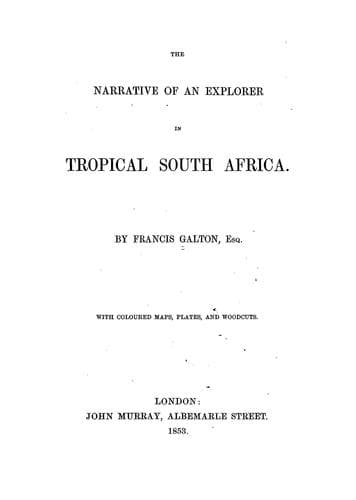
The narrative of an explorer in tropical South AfricaGalton, Francis
History
The narrative of an explorer in tropical South Africa
Galton, Francis
South Africa -- Description and travel
The huts are wretched affairs—I have already slightly described them—the
women are the builders. They first cut a number of sticks eight or nine
feet high, and also strip off quantities of bark from the trees which
they shred and use as string; holes are then “crowed” in a circle of
eight or ten feet across, in which the sticks are planted upright,
their tops are next bent together and pleached and lashed with the bark
shreds—this makes the frame-work; round about it brushwood is woven
and tied until the whole assumes a compact surface; a hole for a door
three feet by two, is left in one side, and a forked prop is placed in
the middle of the hut to support the roof; the whole is then daubed and
plastered over, and the work is completed. As the roof becomes dried
and cracked with the heat of the fire, and indeed as it generally has a
hole in it for a chimney, the Damaras lay old ox-hides on the outside
upon its top, weighting them with stones that they may not be blown
off; these they draw aside when they want ventilation, but pull them
over at night when they wish to make all snug. The furniture of the hut
consists of a couple of ox-hides for lying and sitting on, three or four
wooden vessels, a clay cooking pot, a bag of pig-nuts, a leathern box
containing a little finery, such as red iron earth to colour themselves
with, and a small skin of grease. There may perhaps be an iron knife
and a wood chopper; everything else is worn on the persons, or buried
secretly in the ground. When they sleep, the whole population of the
hut lie huddled up together like pigs, and in every imaginable position
round the small fire. They have nothing to cover themselves with. The
children, before they can walk, are carried in a kind of leather shawl at
the mother’s back; afterwards they are left to shift for themselves, and
pick up a living amongst the pig-nuts as well as they can. They all have
dreadfully swelled stomachs, and emaciated figures. It is wonderful how
they can grow up into such fine men. The Damaras do not dance much, only
on great occasions, when they perform war-dances; neither do they sing
together, although they are very fond of chaunting solos in a sing-song
air, inventing the words as they go on, and having a chorus to break in
now and then. I have seen one guitar amongst them, but it was I think an
Ovampo importation; their only musical instrument is their bow. They tie
a piece of reim round the bow-string and the handle, and bind them up
tight together, then they hold the bow horizontally against their teeth,
and strike the tense bow-string with a small stick. A good performer can
produce great effect with it; they attend more to the rhythm than the
notes, and imitate with its music the gallop or trotting of different
animals to perfection. The baboon’s clumsy canter is the _chef d’œuvre_,
and when well executed makes everybody roar with laughter.
Public-domain text, read in full here on John Shaqi.
Reviews
Reviews
No reviews yet
Be the first to share your thoughts on this work.
Elsewhere in the archive
Join the Discussion
Join the discussion
Sign in to leave a comment or review.
Sign InorCreate an account