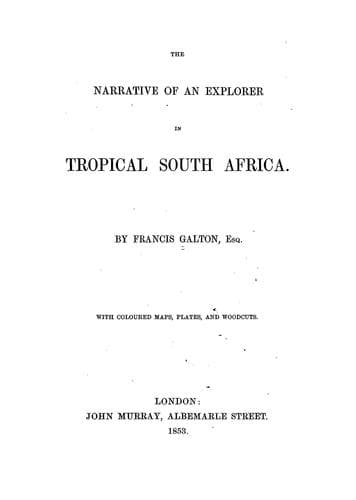
The narrative of an explorer in tropical South AfricaGalton, Francis
History
The narrative of an explorer in tropical South Africa
Galton, Francis
South Africa -- Description and travel
Again, notwithstanding that everything comes out of the tree, men have
in some separate manner a special origin or “eanda.” There are six
or seven eandas, and each eanda has some peculiar rites. The tribes
do not correspond with the eandas, as men of every descent are to be
found in each tribe. The chiefs of tribes have some kind of sacerdotal
authority—more so than a military one. They bless the oxen; and their
daughters sprinkle the fattest ones with a brush dipped in water every
morning as they walk out of the kraal. They have no expectation of a
future state; yet they pray over the graves of their parents for oxen and
sheep,—fat ones, and of the right colour. There is hardly a particle of
romance, or affection, or poetry, in their character or creed; but they
are a greedy, heartless, silly set of savages. Independently of the tree
and the eanda, there is also Omakuru; he can hardly be called a deity,
though he gives and withholds rain. He is buried in several different
places, at all of which he is occasionally prayed to.
The Damaras have a vast number of small superstitions, but these
are all stupid, and often very gross; and there is not much that is
characteristic in them. Messengers are greased before they set out on a
journey, and greased again when they come back; of one sort of ox only
grown men eat; out of one particular calabash of milk only grown men
drink, and so on _ad infinitum_. A new-born child is washed—the only time
he is ever washed in his life—then dried and greased, and the ceremony
is over. Some time during boyhood the lads are circumcised, but at no
particular age. Marriage takes place at what appears to be the ages of 15
or 16, but as the Damaras keep no count of years it is scarcely possible
to be certain of their ages; my impression was that the Damaras were not
so precocious as black people usually are. The teeth are chipped with
a flint when the children are young. After death the corpse is placed
in a squatting posture, with its chin resting on its knees, and in that
position is sewn up in an old ox-hide (the usual thing that they sleep
on), and then dropped down into a hole that is dug for it, the face
being turned to the north, and covered over; lastly, the spectators jump
backwards and forwards over the grave to keep the disease from rising out
of it. A sick person meets with no compassion; he is pushed out of his
hut by his relations away from the fire into the cold; they do all they
can to expedite his death, and when he appears to be dying, they heap
ox-hides over him till he is suffocated. Very few Damaras die a natural
death.
Public-domain text, read in full here on John Shaqi.
Reviews
Reviews
No reviews yet
Be the first to share your thoughts on this work.
Elsewhere in the archive
Join the Discussion
Join the discussion
Sign in to leave a comment or review.
Sign InorCreate an account