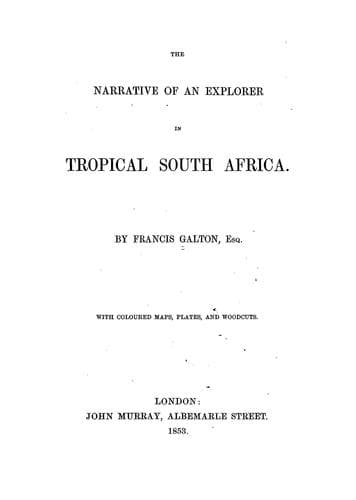
The narrative of an explorer in tropical South AfricaGalton, Francis
History
The narrative of an explorer in tropical South Africa
Galton, Francis
South Africa -- Description and travel
I cannot speak with certainty of the exact standing in which the Damaras
and the Bushmen severally live among the Ovampo. The first are employed
principally as cattle-watchers; the second, who are even more ornamented
than the Ovampo themselves, are a kind of standing army; but I have great
reason to doubt whether either the one or the other class is independent.
The Ovampo, as I have mentioned, looked down with much contempt on the
Damaras; and there is not a single instance, so far as I could learn, of
an Ovampo-woman marrying a Damara, and settling in Damara-land; but the
reverse is a very common case. The Bushmen appear to be naturalised among
the negro-tribes, and free in the border-lands between them to a distance
very far north of Ondonga. I cannot say how far; but I certainly think to
the latitude of Caconda. I believe them to be a very widely spread race.
Of the Ghou Damup I lost all trace in Ovampo-land. The Namaqua Hottentots
and Oerlams, in all their plundering excursions, capture and drive back
with them such Damara youths as they take a fancy to, and they keep them,
and assert every kind of right over them. They punish them just as they
please, and even shoot them, without any one attempting to interfere.
Next in the scale of slavery are those Damaras, Ghou Damup, or Bushmen,
who place themselves under Hottentot “protection,” and on much the same
footing as those among the Hottentots, are the paupers that are attached
to different werfts among the Damaras. These savages _court slavery_. You
engage one of them as a servant, and you find that he considers himself
your property, and that you are, in fact, become the owner of a slave.
They have no independence about them, generally speaking, but follow a
master as spaniels would. Their hero-worship is directed to people who
have wit and strength enough to ill-use them. Revenge is a very transient
passion in their character: it gives way to admiration of the oppressor.
The Damaras seem to me to love nothing: the only strong feelings they
possess, which are not utterly gross and sensual, are those of admiration
and fear. They seem to be made for slavery, and naturally fall into its
ways. Their usual phrase with reference to the missionaries is, “Oh, they
are wise, but weak;” but Jonker and the Hottentots are, I could almost
say, their delight. They wonder at their success.
Public-domain text, read in full here on John Shaqi.
Reviews
Reviews
No reviews yet
Be the first to share your thoughts on this work.
Elsewhere in the archive
Join the Discussion
Join the discussion
Sign in to leave a comment or review.
Sign InorCreate an account