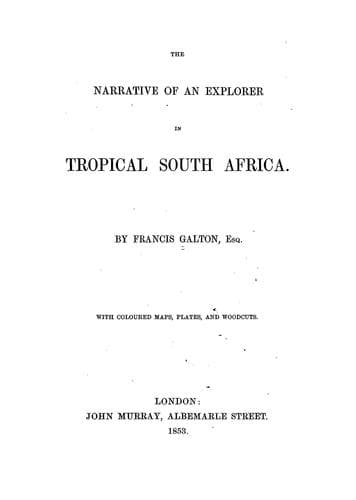
The narrative of an explorer in tropical South AfricaGalton, Francis
History
The narrative of an explorer in tropical South Africa
Galton, Francis
South Africa -- Description and travel
All over Africa one hears of “giving” men away: the custom is as follows.
A negro has chanced to live a certain time in another’s employ; he
considers himself his property, and has abandoned the trouble of thinking
what he is to do from day to day; but leaves the ordering of his future
entirely to his employer. He becomes too listless to exist without a
master. The weight of independence is heavier than he likes, and he will
not bear it. He feels unsupported and lost if alone in the world, and
absolutely requires somebody to direct him. Now, if the employer happens
to have no further need of the man, he “gives” him, that is to say, he
makes over his interest in the savage to a friend or acquaintance; the
savage passively agrees to the bargain, and changes his place without
regret; for, so long as he has a master at all, the primary want of his
being is satisfied. A man is “given” either for a term or for ever; and
it was on this tenure that I held several of my men. Swartboy gave me
his henchman; Kahikenè, a cattle-watcher; Mr. Hahn, a very useful man,
Kambanya. As a definition of the phrase “giving a man,” I should say
it meant “making over to another whatever influence one possessed over
a savage; the individual who is given not being compelled, but being
passive.”
Before starting on my return I bought as much corn as I could carry back,
which also proved to be exactly as much as I could buy with my stock of
beads. I knew by this time pretty well what weights the different oxen
could carry, and arranged their saddle-bags accordingly. I always carried
a couple of spring balances with me when on ride-oxen, and as they each
marked up to forty pounds, by using the two together I could weigh up
to eighty pounds, which was as much as I ever wanted on this occasion,
though afterwards when ivory had to be earned I was put to shifts for
weighing it. It saves infinite trouble in packing to have the two
saddle-bags of exactly the same weight, and I am sure that no practice
will train the hand to judge with certainty whether they are so; a small
heavy thing always feels lighter than its real weight, and a bulky thing
heavier. I have constantly tested the guesses that practised muleteers
and camel-drivers have made of the weights of things, and often convicted
them of great mistakes. In my waggon I carried a steel-yard, and knew
and registered the weight of everything I carried.
I mentioned that the Ovampo had fowls; they are very pretty small
bantams, and I bought three—thinking that being a new breed they might
have some points about them which would be valuable to poultry fanciers;
they eat very little, and laid eggs every day. I put them in an Ovampo
basket, covered it with a piece of skin, and made one of the Damara women
carry it on her head.
Public-domain text, read in full here on John Shaqi.
Reviews
Reviews
No reviews yet
Be the first to share your thoughts on this work.
Elsewhere in the archive
Join the Discussion
Join the discussion
Sign in to leave a comment or review.
Sign InorCreate an account