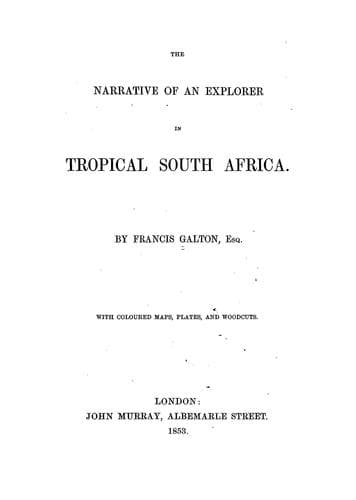
The narrative of an explorer in tropical South AfricaGalton, Francis
History
The narrative of an explorer in tropical South Africa
Galton, Francis
South Africa -- Description and travel
All this was delightful, and we off-packed our lean oxen in the highest
spirits about a quarter of a mile from the water, in the midst of a thick
grove of trees. Amiral encamped near us; we made a kraal and settled down
for at least a week’s pleasuring. As soon as the elephant was disposed
of, I collected all the chief Bushmen in a ring, and gave them tobacco
and so forth, and began asking them about the country further on ahead.
One of my men came to say that he had just found a Bushman cooking with
a large iron pot; this was a sure sign of the neighbourhood of civilised
man. The Bushman said that it was given to them by people from a waggon
some distance to the east, and who had gone to the lake during the
previous rainy season. The man who had guided the Kubabees Hottentots
lived here—Toes-u-wap was his melodious name. He and the other Bushman
wore great numbers of elephant hair necklaces, with three or four beads
strung on each of them; they are, as I now find, worked after the manner
that the English ladies call “tatting.” Old Buffaloe’s son and Toes-u-wap
were the only two who could understand much of the language of the
Hottentots; they interpreted for us to the other Bushmen as well as they
could, but our conversation was far from fluent. Several of these Bushmen
knew the Mationa language, and as I had a little MS. Sichuana dictionary
with me, I asked the Sichuana names for sixty words; of these about
twenty were identical with those in my dictionary, twenty were somewhat
like them, and the other twenty I could not find. I presume, therefore,
that their language is Sichuana, or a dialect of it. The Bushmen were
unanimous in saying that our next stage to the east was longer than the
one we had just travelled. The season was so excessively dry that all the
wells were exhausted. The Kubabees Hottentots had passed by this place
in the dry season, but it was subsequent to an ordinarily rainy summer,
and they left ’Tounobis in the afternoon, travelled all night, and next
midday drank water with reeds, after their manner, from a place where the
sand was damp; on the ensuing day they came to a Bushman werft, and so on
every day till the fifth, when they reached a Mationa cattle-post; they
call it Eisis in Hottentot, Chuèsa in Mationa language; from there the
hills that border the great water (river or lake I am not sure which) can
be seen. There is said to be much game there.
We had great difficulty in making the Bushmen distinguish between the
lake and the rivers; they called the whole water-country by one name—Tl’
Annee. However, I will not enter at length into these details, as more
accurate information will certainly be received before long from the
whites, or whiter races, who are now steadily pushing northwards.
Public-domain text, read in full here on John Shaqi.
Reviews
Reviews
No reviews yet
Be the first to share your thoughts on this work.
Elsewhere in the archive
Join the Discussion
Join the discussion
Sign in to leave a comment or review.
Sign InorCreate an account