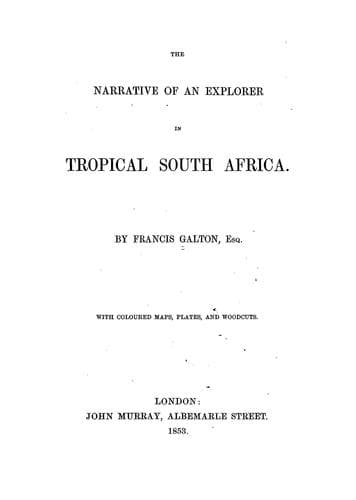
The narrative of an explorer in tropical South AfricaGalton, Francis
History
The narrative of an explorer in tropical South Africa
Galton, Francis
South Africa -- Description and travel
The animals are picked up in the morning; but it is not very easy to
find them. Spooring is, in most cases, quite out of the question, on
account of the numberless tracks. The Bushmen jerked every particle of
the meat of all the animals that we killed, excepting that which we used
ourselves. I like rhinoceros flesh more than that of any other wild
animal. A young calf, rolled up in a piece of spare hide, and baked in
the earth is excellent. I hardly know which part of the little animal is
the best, the skin or the flesh.
The Hottentots shot away a great many bullets at rhinoceroses, and did, I
dare say, a great deal of mischief; for they lie six or seven together
in each shooting-screen, and blaze volleys at long distances—often thirty
or forty yards—at the rhinoceros. The consequence is that they “bag”
but very few, compared to the number that they fire at; the others most
likely linger on for a few days, and then lie down and die elsewhere.
One night Andersson and myself were lying out together when a rhinoceros
came, that I fired at. Something smaller was following at its heels; but
we could not see what, on account of the shade of the dark bushes. It was
a brilliant moonlight; and we were foolish enough to leave our screen,
and poke about after the animal, which luckily we never found. In the
early morning Andersson went to look for the game that had been shot; and
first followed the spoor of the rhinoceros we had been seeking. He soon
found the animal lying dead among the bushes; and he walked carelessly
up, with rifle over his shoulder, when as he was just upon the animal, a
full-grown calf rushed out from behind its dead mother right at him. He
had a very narrow escape, for the creature brushed by him in the narrow
pathway: he was about as large as an ox, and his spoor was half size. Had
we come upon them the preceding night, we should have run some risk. On
one occasion a rhinoceros that he fired at, brushed down the stones of
one side of his shooting-place.
If I were to travel again on a shooting-tour, I should certainly
take a large opera-glass with me. It is one of the most perfect of
night-glasses, besides being the most useful of telescopes. I should
think it would put a man’s sight in the dusk on a par with that of wild
beasts generally; and it is so portable and manageable an instrument,
that I should never lie out watching for animals without one.
Since my return to England I have often amused myself at night in trying
their powers, which certainly are marvellous. At sea they are coming into
general use, and more than one naval officer of considerable experience,
in chasing slavers, has assured me of their great superiority over the
ordinary cumbrous night telescope. Talking of these things, I may add,
that a powerfully magnifying telescope is of very little use in tropical
Africa; the air is always seething and waving from the heat, so that
images are seldom sufficiently distinct to be worth magnifying.
Public-domain text, read in full here on John Shaqi.
Reviews
Reviews
No reviews yet
Be the first to share your thoughts on this work.
Elsewhere in the archive
Join the Discussion
Join the discussion
Sign in to leave a comment or review.
Sign InorCreate an account